Let’s be honest. Nobody wakes up excited to buy life insurance.
It’s one of those grown-up tasks we know we should do, but we keep putting it off because it’s confusing, a little morbid, and frankly, there are a million other things competing for our attention and our money.
But here’s the thing. If you have people who depend on you—a spouse, kids, aging parents—life insurance is one of the most important financial decisions you’ll ever make. It’s the ultimate safety net. It ensures that if the worst happens, the people you love won’t lose their home, their stability, or their future.
The problem? There are two main types of policies, and they work completely differently.
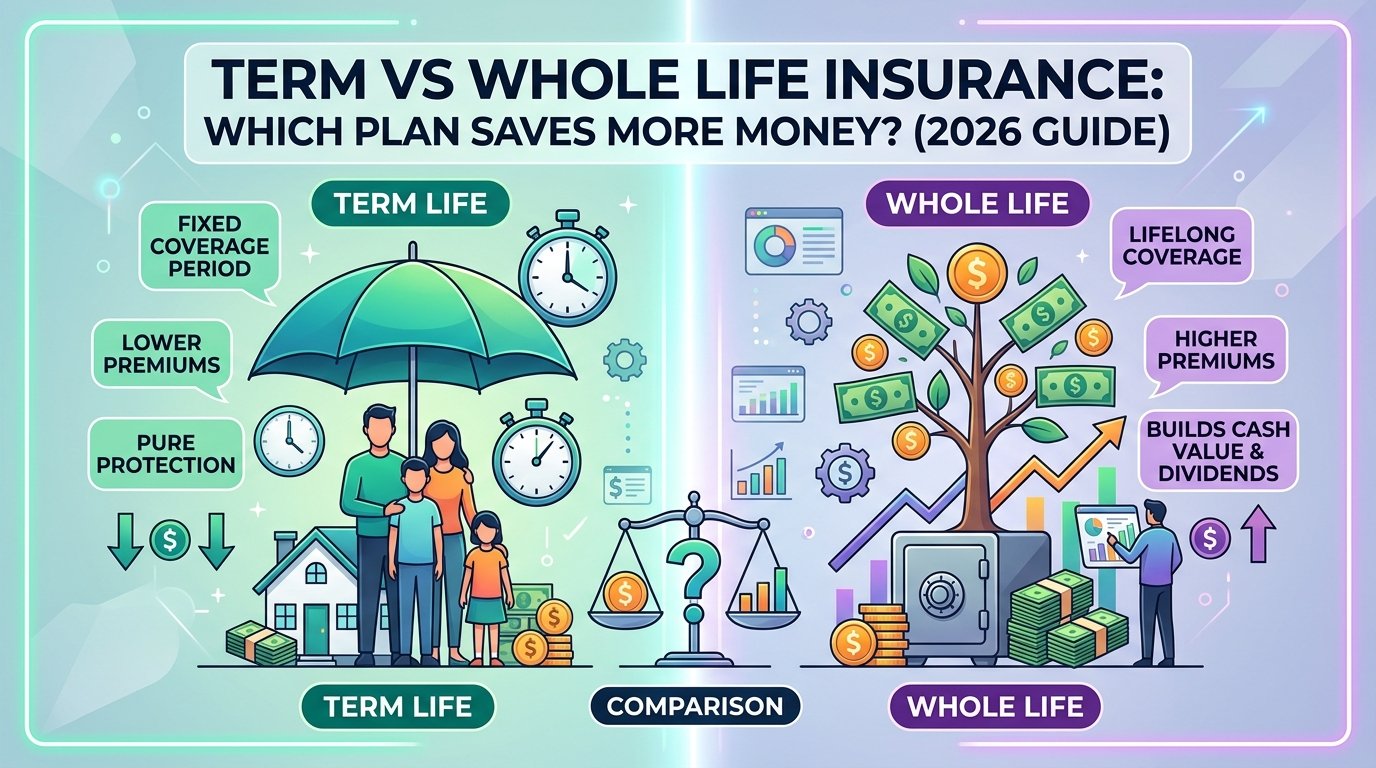
Term life insurance is simple and cheap. You buy coverage for a set number of years, and if you die during that time, your family gets paid.
Whole life insurance is more complex and much more expensive. It covers you for your entire life, and it builds cash value over time that you can actually use while you’re still alive.
So which one saves you more money? Which one is the smarter choice?
The answer isn’t as simple as you might think. It depends on your goals, your budget, and what you mean by “save money.”
In this guide, I’m going to walk you through everything you need to know. We’ll compare costs, break down the cash value feature of whole life insurance, look at real numbers, and help you decide which path is right for your family.
Let’s dive in.
The Big Picture: How These Policies Differ
Before we get into the weeds, let’s zoom out and look at the big differences.
| Feature | Term Life Insurance | Whole Life Insurance |
|---|---|---|
| Duration | Fixed term (10, 20, or 30 years) | Lifetime (to age 100 or 121) |
| Premiums | Lower, especially early in life | Much higher (5 to 20 times more) |
| Cash Value | None | Yes—grows tax-deferred over time |
| Death Benefit | Only if you die during the term | Always, as long as premiums are paid |
| Investment Component | No | Yes (conservative, guaranteed growth) |
| Best Use Case | Income replacement during working years | Estate planning, lifelong dependents, legacy |
Whole life insurance is a subset of permanent life insurance. It provides lifelong coverage, a guaranteed death benefit (if premiums are paid), and a cash value component that accumulates over time .
Term life, on the other hand, is often called “pure life insurance.” There’s no cash value—it’s designed purely to give your beneficiaries a payout if you die during the term .
What Is Term Life Insurance?
Let’s start with the simpler option.
Term life insurance provides coverage for a specific period—usually 10, 20, or 30 years . If you die during that term, your beneficiaries receive a lump sum death benefit. If you outlive the term, the coverage ends, and you get nothing back .
Think of it like car insurance. You pay your premium every month, and if you get into an accident, the insurance pays. If you don’t, you don’t get your money back. You paid for protection, and you got exactly that.
Who Is Term Life Best For?

Term insurance is ideal when you have a life insurance need for a specific time period . Common scenarios include:
- Until your kids graduate from college. You want to make sure they’re taken care of while they’re dependent on you.
- Until you pay off your mortgage. If you died, you wouldn’t want your family to lose the house.
- Until you retire. Once you’re no longer earning an income, your family may not need a massive payout to replace your salary.
Term life is also the way to get the largest death benefit for the lowest premium . If you’re on a tight budget but need serious coverage, term is usually your best bet.
The Pros and Cons of Term Life
Pros:
- Less expensive than whole life insurance or other permanent policies
- Designed for a specific period when your family needs protection most
- Can usually be converted to permanent coverage (details vary by insurer)
- Simple and straightforward—you know exactly what you’re getting
Cons:
- The low rates end when the level term period expires
- Renewing coverage after the term can be expensive or difficult, especially if your health has declined
- No cash value—you don’t build any savings or equity
- Nothing to show if you outlive the policy (though that’s actually the goal!)
What Is Whole Life Insurance?
Now let’s talk about the more complex option.
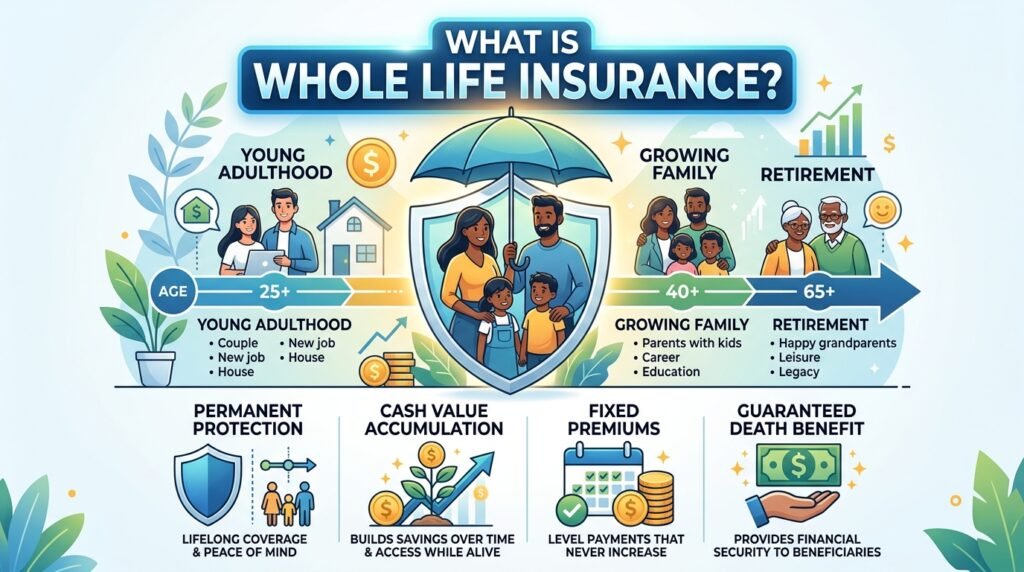
Whole life insurance is a type of permanent life insurance that provides coverage for your entire lifetime—as long as you pay the premiums . It offers a fixed premium and a guaranteed death benefit.
But here’s where it gets different. Whole life insurance also builds a savings feature called cash value .
How Cash Value Works
Part of your premium goes toward the death benefit, part goes toward policy expenses, and the rest goes into a cash value account . This cash value grows over time on a tax-deferred basis .
Whole life insurance policies typically guarantee a minimum interest rate on your cash value. Some policies—called “participating policies”—may also pay dividends based on the insurance company’s financial performance . These dividends aren’t guaranteed, but some insurers have paid them for many years.
You can access this cash value while you’re still alive. Options include:
- Withdrawals: You can take money out, though withdrawals beyond what you paid in premiums may be taxable .
- Policy loans: You can borrow against the cash value .
- Pay premiums: In some cases, you can use cash value to pay your premiums.
Important warning: Any money you withdraw or borrow (if not repaid) reduces the death benefit paid to your beneficiaries .
Who Is Whole Life Insurance Best For?
Whole life insurance is best if you want guaranteed, lifelong coverage with fixed premiums and cash value growth . Specific situations include :
- Supporting a child with special needs for their lifetime
- Equalizing an estate—for example, leaving a family business to one child and life insurance to another
- Leaving a legacy for your children or a charity, no matter how long you live
- Providing income for a spouse if your pension payouts stop after you die
- Paying estate taxes so your heirs don’t have to sell assets
- Supplementing retirement income later in life (though this reduces the death benefit)
The Pros and Cons of Whole Life Insurance
Pros:
- Coverage lasts a lifetime as long as premiums are paid
- Premiums are level for the life of the policy—easy to budget
- Builds cash value at a guaranteed rate, with potential dividends
- Tax-deferred growth on the cash value
- Access to cash through loans or withdrawals
Cons:
- Much more expensive than term life coverage—it can cost 5 to 20 times more
- Cash value takes years to build due to upfront costs
- Lower returns compared to investing in the stock market
- Complexity—it’s harder to understand what you’re getting
- Loans and withdrawals reduce the death benefit
The Cost Difference: How Much More Is Whole Life?
This is where the rubber meets the road. The cost difference between term and whole life insurance is staggering.
Let’s look at some real numbers.
Example 1: Healthy 30-Year-Old Non-Smoker
According to Policygenius data cited by Benzinga :
- $500,000, 20-year term: ~$18–$25 per month
- $500,000 whole life: $400+ per month
That’s 16 to 22 times more expensive for whole life insurance.
Example 2: 40-Year-Old Male
Data from Aflac, also cited by Benzinga :
- $500,000, 20-year term: ~$335 per year (about $28/month)
- $500,000 whole life: ~$7,028 per year (about $586/month)
That’s 21 times more for whole life insurance in this example.
Example 3: Guardian Life Quote
Guardian’s calculator shows that a 30-year-old non-smoking female can get $1,000,000 of 20-year term coverage for $48 a month. That same coverage with a 30-year term jumps to $96 a month . And whole life insurance would be dramatically higher.
Why Is Whole Life So Much More Expensive?
There are three main reasons :
- Lifelong coverage: With term, the insurer only pays if you die during the term. With whole life insurance, a payout is all but guaranteed eventually. That certainty costs money .
- Cash value component: Part of your premium goes into the cash value account. You’re not just buying insurance; you’re also saving .
- Level premiums forever: The insurer is charging you more when you’re young to cover the much higher cost of insuring you when you’re old .
The “Buy Term and Invest the Difference” Strategy
Given the massive cost difference, many financial advisors recommend a simple strategy: buy term life insurance and invest the difference .
Here’s how it works.
Let’s say you’re 30 years old and considering a $500,000 whole life insurance policy for $400 per month. Instead, you buy a $500,000 term policy for $25 per month. You take the remaining $375 per month and invest it in a diversified portfolio of low-cost index funds.
Over 30 years, assuming a 7% average annual return, that $375 per month could grow to over $450,000. You’d have:
- Life insurance protection for the years you need it most
- A significant investment account you can access anytime, without loans or restrictions
- No reduction in death benefit from outstanding loans
- More control over your money
And if you die during those 30 years, your family gets the $500,000 death benefit plus the investment account.
This is why Edelman Financial Engines states: “Generally speaking, we believe term insurance covers most people’s needs sufficiently” .
When Whole Life Insurance Actually Makes Sense
Now, I’m not here to bash whole life insurance. It has legitimate uses. It’s just not right for most people.
Here are the situations where whole life insurance can be a smart move .
1. Lifelong Dependents
If you have a child with special needs who will require care and financial support for their entire life, whole life insurance guarantees that money will be there when you’re gone . Term insurance could expire before your child does, leaving them unprotected.
2. Estate Planning and Tax Mitigation
For wealthy families, whole life insurance can provide liquidity to pay estate taxes . This prevents heirs from having to sell a family business or other assets to cover the tax bill. The death benefit can also be used to equalize inheritances—leaving the business to one child and insurance proceeds to another .
3. Guaranteed Pricing and Predictability
Some people value certainty above all else. Whole life insurance locks in your premiums and death benefit for life . You never have to worry about renewing coverage at older ages when it becomes expensive or impossible due to health issues .
4. Maximum Tax-Advantaged Savings
If you’ve already maxed out your 401(k), IRA, and other tax-advantaged accounts, whole life insurance offers another vehicle for tax-deferred growth . The cash value grows tax-deferred, and policy loans can be taken tax-free (though they reduce the death benefit).
5. Business Planning
Business owners often use whole life insurance for key person insurance, buy-sell agreements, and cross-purchase arrangements . The permanent nature of the coverage ensures the protection never expires.
The Risk of Lapsing a Whole Life Policy

Here’s something many people don’t realize. Whole life insurance is only valuable if you keep it in force for your entire life.
If you let the policy lapse—stop paying premiums—you could lose much of what you’ve put in, especially in the early years. The Society of Actuaries studies show that whole life insurance policies have stronger persistency (fewer lapses) than term, but lapses still happen .
The consequences of lapsing can be severe:
- You may receive a surrender value far less than you’ve paid in premiums
- You lose the death benefit protection
- You may face tax consequences on any gains
This is why Guardian advises that if you think you might not need coverage for your entire life, term insurance is probably a better fit .
Can You Have Both? Stacking Policies
Here’s an idea that might be the best of both worlds. You don’t have to choose just one.
Stacking refers to combining multiple life insurance policies to increase the death benefit and tailor coverage to different needs .
- A term life policy to cover your mortgage and kids’ education during your working years
- A smaller whole life insurance policy for lifelong protection and cash value accumulation
As you progress through your career, you might increase your coverage by adding policies rather than replacing them . This allows you to adapt to changing needs while maintaining the benefits of both types.
Benzinga notes that households combining term and permanent coverage have “higher odds of being financially adequate” .
Converting Term to Whole Life
Many term life policies include a conversion option. This allows you to switch to a permanent policy (usually whole life insurance or universal life) without new medical underwriting .
This feature can be invaluable if your health changes later. You can lock in lifetime coverage even if you’ve developed health conditions that would otherwise make new insurance unaffordable .
Conversion windows typically last between 10 and 20 years or until a specific age (often 65) . Guardian lets you convert at any point in the first five years, with an optional rider extending that for the full term .
Even if you don’t convert the entire face amount, converting a partial amount can give you lifelong protection while keeping premiums manageable .
Step-by-Step Decision Framework
Still not sure which way to go? Here’s a practical framework adapted from Benzinga .
| Step | Question to Ask | Decision Signal |
|---|---|---|
| 1 | What is your time-limited coverage need? (e.g., until kids are independent, mortgage paid) | If your major obligations fade, term may dominate |
| 2 | What’s your budget flexibility for premiums over 10–30+ years? | If tight, heavy permanent premiums may stress cash flow |
| 3 | Do you have lifelong obligations or a legacy goal? | If yes, permanent has appeal |
| 4 | What’s your return expectation vs opportunity cost of investing elsewhere? | If you believe you can beat conservative policy returns, term + investment may win |
| 5 | Do you want guaranteed pricing and predictability? | Permanent delivers that certainty |
| 6 | How much value do you place on policy liquidity (loans, withdrawals)? | If high, valuing access, permanent offers more flexibility |
| 7 | Will you consider a hybrid/laddered/blended approach? | Often the practical compromise |
Frequently Asked Questions
Q: What is the main difference between term and whole life insurance?
A: Term life provides coverage for a specific period (like 20 years) and has no cash value. Whole life insurance provides coverage for your entire life and builds cash value over time .
Q: How much more expensive is whole life insurance?
A: Whole life insurance can cost 5 to 20 times more than term life for the same death benefit . A 30-year-old might pay $25/month for term and $400+/month for whole life insurance .
Q: Is whole life insurance worth the cost?
A: It depends on your situation. Whole life insurance is worth it if you need lifelong coverage, have estate planning needs, or want guaranteed cash value growth. For most people, term insurance plus investing the difference makes more financial sense .
Q: Can I access the cash value in a whole life policy?
A: Yes. You can take withdrawals or policy loans against the cash value . However, any money you withdraw or borrow (if not repaid) reduces the death benefit .
Q: What happens if I outlive my term life policy?
A: The coverage ends, and you get nothing back . Some insurers offer “return of premium” term policies that refund your premiums at maturity, but these cost much more .
Q: Can I convert my term policy to whole life?
A: Many term policies include a conversion option that lets you switch to permanent coverage without a new medical exam . Conversion windows vary by insurer.
Q: What is the cash value growth rate for whole life insurance?
A: Whole life insurance typically guarantees a minimum interest rate on cash value. Participating policies may also pay dividends, but these aren’t guaranteed . Growth is generally conservative compared to stock market investments .
Q: Which type of life insurance do most Americans have?
A: According to the Survey of Consumer Finances, among households with life insurance, 54% hold term, 8% hold permanent only, and 10% hold both .
The Smarter Way to Protect Your Family
After looking at all the numbers and all the scenarios, here’s the bottom line.
For the vast majority of families, term life insurance is the smarter financial choice. It gives you the protection you need during the years when your family depends on you most. It frees up money that you can invest for retirement, college, or other goals. It’s simple, transparent, and does exactly what most people need it to do.
Whole life insurance has its place. If you have lifelong dependents, significant estate tax exposure, or a desire for guaranteed cash value growth that you can’t get elsewhere, it can be a valuable tool. But those situations are the exception, not the rule.
The key is to be honest with yourself about your goals, your budget, and what you’re trying to accomplish. Ask yourself:
- How long do my dependents actually need protection?
- Can I afford the much higher premiums of whole life insurance?
- What could I do with the money I’d save by buying term instead?
For most people, the answer will point toward term insurance plus smart investing. That combination offers protection, flexibility, and the potential for real wealth building—all while saving money compared to whole life insurance.
Your family’s financial security is too important to get wrong. Choose the path that gives you the most protection for your money and the most flexibility for your future.
Here’s to making smart choices and sleeping better at night.