Looking for steady income? We explore the best safe dividend stocks to buy in 2026 for long-term growth. Learn how to build a portfolio that pays you back.
We all know the feeling. You check your bank savings account, and the interest rate makes you sigh. It’s barely a drop in the bucket. With the cost of living always creeping up, parking your cash in a standard savings account just doesn’t cut it anymore. You need your money to work for you.
That’s where the stock market comes in. But let’s be honest, the thought of buying stocks can be scary. Prices go up and down. News headlines scream about crashes and rallies. It feels like gambling sometimes.How to open Brokerage Account.
But here is the secret that wealthy investors have known for generations: you don’t have to gamble. You can invest in safe dividend stocks to buy.
Think of a dividend stock not just as a piece of a company, but as a rental property. When you buy a rental house, you hope the value goes up over time (capital appreciation), but in the meantime, you collect rent checks every month (dividends). That monthly rent is cash in your pocket. You can spend it, or you can save it to buy another house.Safe Dividend Stocks to Buy in 2026
That is the magic of dividends. And when you find companies that are safe, stable, and grow those “rent checks” every year, you set yourself up for a very comfortable future.Safe Dividend Stocks to Buy in 2026
As we move through 2026, the economic landscape is shifting. Interest rates are settling, new technologies are emerging, and old habits are dying. But some things remain constant: people need energy, they need medicine, they need a place to live, and they need their morning coffee.Safe Dividend Stocks to Buy in 2026
In this guide, we are going to walk through exactly what makes a dividend stock “safe,” why 2026 is a great year to be a dividend hunter, and a curated list of the best safe dividend stocks to buy right now for long-term growth.
Let’s dive in and start building that portfolio of “rental properties.”
What Makes a Dividend Stock “Safe”?
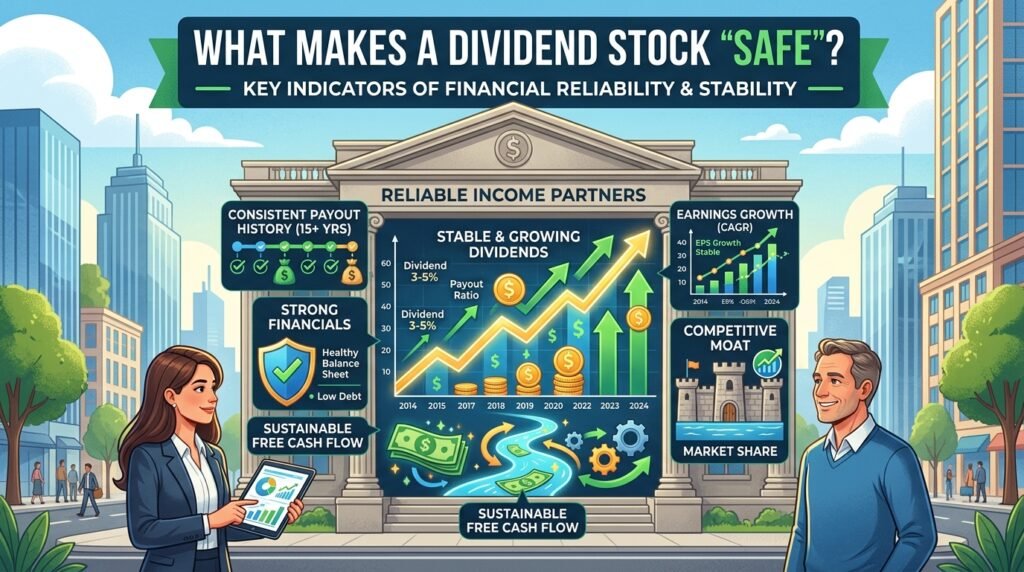
Before we start naming names, we have to lay the foundation. Not all dividends are created equal. Some are traps. A stock might offer a huge 10% yield, but that could be a sign that the company is in trouble and the stock price has collapsed.Safe Dividend Stocks to Buy in 2026
When we talk about safe dividend stocks to buy, we are looking for specific traits. These are the guardrails that keep us on the road.
The Dividend Aristocrats and Kings
You want to invest in companies with a track record. If a business has been paying and raising its dividend for 25, 30, or even 50 years, they know how to weather a storm .Safe Dividend Stocks to Buy in 2026
- Dividend Kings have increased payouts for over 50 years.
- Dividend Aristocrats have done so for at least 25 years.
These companies have survived recessions, wars, and pandemics. They prove their business model works year after year .
The Payout Ratio
This is a fancy term, but it’s simple math. The payout ratio is the percentage of earnings a company pays out as dividends.Safe Dividend Stocks to Buy in 2026
- If a company earns $1 per share and pays you $0.50, the payout ratio is 50%.
A lower ratio (usually under 75%) means the company has room to grow the dividend and reinvest in the business. A high ratio (over 90%) might mean the dividend is at risk of being cut if profits dip .
Economic Moat
Warren Buffett popularized this term. An economic moat is what protects a company from competitors.Safe Dividend Stocks to Buy in 2026
- Is it a brand everyone trusts? (Like Coca-Cola)
- Is it a utility that has a monopoly in a region? (Like a power company)
- Is it an infrastructure that is too expensive to build again? (Like a pipeline)
A wide moat keeps the profits flowing for decades.
Why 2026 is a Prime Year for Dividend Investing
You might be thinking, “Why should I start now?” The market in early 2026 has shown some interesting trends. With all the talk about artificial intelligence and geopolitical tensions, the market has been rocky . But that volatility actually pushes smart money toward safety.
In fact, Dividend Aristocrats have been outperforming the broader S&P 500 this year . Why? Because when the economy feels uncertain, investors flock to companies that generate real cash and share it with you. They are tired of paying high prices for “story stocks” that have no profits.
Additionally, interest rates seem to be stabilizing. For a while, bonds were a competitor to dividend stocks. But now, the balance is shifting back. Companies with pricing power, like Home Depot, are poised to benefit as the housing market adjusts to the new normal .Safe Dividend Stocks to Buy in 2026
Now, let’s get to the good stuff. Here are our top picks for safe dividend stocks to buy in 2026.
Top Safe Dividend Stocks to Buy in 2026
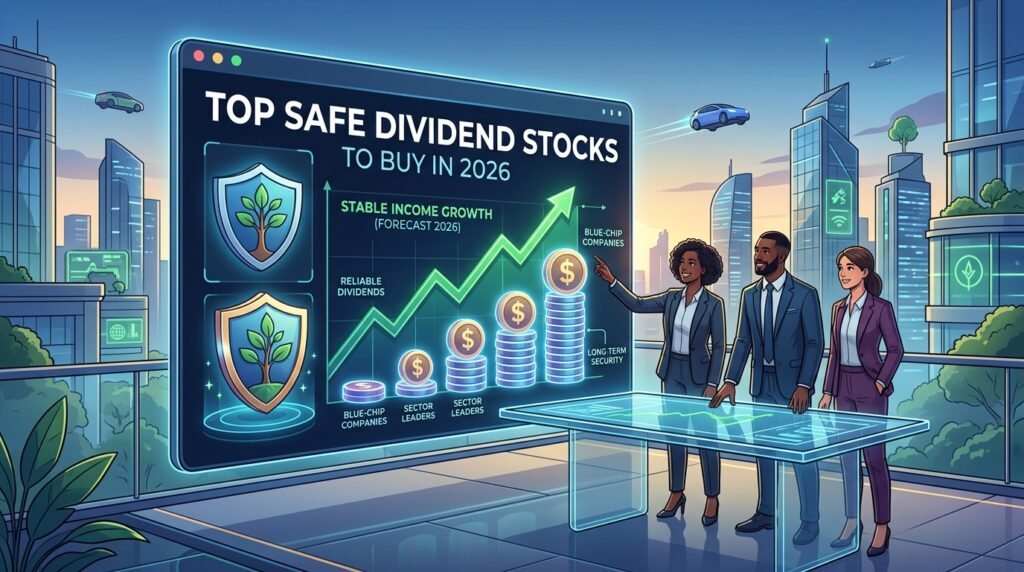
We have broken this list down by sector. Just like you wouldn’t fill your fridge with only milk, you shouldn’t fill your portfolio with only one type of stock. Diversification is key to safety.Safe Dividend Stocks to Buy in 2026
1. The Consumer Staples Champions
These are the companies that sell the stuff we buy every single day. When times are tough, we might cancel the fancy vacation, but we still need toothpaste and soda.Safe Dividend Stocks to Buy in 2026
Coca-Cola (KO)
Let’s start with the king of beverages. Coca-Cola just announced its 64th consecutive year of dividend increases . Think about that. 64 years. Your grandparents could have bought this stock, and they would have seen a raise in their “rent check” almost every year of their lives.Safe Dividend Stocks to Buy in 2026
- The Moat: It’s the brand. There are 30 brands in their portfolio that generate over $1 billion in sales each year . You can’t replicate that overnight.
- The Yield: Currently sitting around 2.6% to 2.9% .
- Why 2026? They are innovating with new drinks like Sprite + Tea and ready-to-drink cocktails. They are adapting to new tastes while keeping the classics alive .
Procter & Gamble (PG)
Look around your bathroom or kitchen right now. Chances are you see a P&G product. Head & Shoulders, Crest, Dawn, Tide, Pampers. These are not luxury items; they are essentials .
- The Moat: Shelf space and brand loyalty. Retailers have to stock Tide because customers demand it. Parents aren’t going to risk a rash just to save a few cents on diapers.
- The Stability: PG has a very low volatility rating (beta of 0.34) . This stock barely flinches when the market gets scared. It’s a perfect anchor for any long-term portfolio.
PepsiCo (PEP)
Pepsi is more than just a Coke rival. They own Frito-Lay. Snacks are a recession-proof business. People might stop buying new cars, but they don’t stop buying chips .
- The Moat: The “Power of One” strategy combines beverages and snacks. It gives them massive leverage with stores.
- The Yield: With a yield near 3.4%, Pepsi offers a slightly higher income than its beverage counterpart, with a 54-year streak of increases .
2. The Energy and Infrastructure Backbone
We live in a world that runs on energy. These companies own the pipes and wires that keep the lights on.
Enbridge (ENB)
If you live in North America, your heat or gas probably flowed through an Enbridge pipe at some point. They describe their business as “utility-like,” and for good reason .
- The Moat: It’s nearly impossible to build new pipelines these days. The existing infrastructure is a national asset.
- The Yield: This is a big one, currently over 5.8% . They just declared their 31st consecutive annual dividend increase .
- Long-Term View: They are expanding into natural gas utilities, ensuring they stay relevant even as the energy mix changes.
MPLX (MPLX)
This is a master limited partnership (MLP), which means it often pays higher yields. MPLX operates in the Marcellus and Permian basins, the heart of U.S. energy production .
- The Moat: Strategic location. They are where the oil and gas is.
- The Yield: A jaw-dropping yield of about 7.4% .
- Why 2026? They plan to grow distributions by 12.5% annually for the next two years. That kind of growth is rare . Note: MLPs have different tax implications, so it’s wise to check with a tax advisor.
Williams Companies (WMB)
Williams is all about natural gas. And natural gas is the bridge fuel to the future. It’s also powering the new wave of data centers for AI .
- The Moat: They are moving into “behind-the-meter” power generation, directly supplying power plants and data centers.
- The Growth: Analysts see EBITDA growth of 12-13% through 2030. This isn’t just a slow-moving pipeline company anymore; it’s a growth engine .
3. The Real Estate Giants (REITs)
Real Estate Investment Trusts (REITs) allow you to own property without having to fix a toilet. By law, they must pay out 90% of their taxable income as dividends.
Realty Income (O)
You will hear people call this “The Monthly Dividend Company” because they pay dividends every single month. It’s like getting a paycheck .
- The Moat: They own over 15,000 properties leased to over 1,600 clients . They are the landlord for places like Walgreens, FedEx, and dollar stores.
- The Streak: They have increased the dividend for 30 consecutive years and 133 consecutive quarters .
- The Yield: Currently near 5.8% . It’s a favorite for retirees for a reason.
4. The Healthcare and Industrial Pillars
These companies benefit from long-term trends like aging populations and the need for infrastructure.Safe Dividend Stocks to Buy in 2026
Medtronic (MDT)
Medtronic makes medical devices, from pacemakers to surgical robots. Once a hospital buys a robot and trains surgeons on it, they are unlikely to switch .
- The Moat: High switching costs and a massive patent portfolio (over 41,000 patents).
- The Trend: As the global population ages, demand for these devices is an “inelastic necessity.” It doesn’t matter if the stock market is up or down; people still need hip replacements .
- The Yield: Around 2.9%, with a 48-year dividend growth streak .
Caterpillar (CAT)
When the world builds, it uses Cat machines. Caterpillar is the go-to for construction and mining equipment .
- The Moat: Their dealer network. It’s expensive and difficult to build a service network as extensive as CAT’s.
- The 2026 Thesis: Governments are spending big on infrastructure. The energy transition requires mining for new materials. Caterpillar is right in the middle of this “super-cycle” .
Home Depot (HD)
With lower interest rates potentially on the horizon, the housing market is expected to thaw. Home Depot is poised to capture that pent-up demand .
- The Moat: They are the 800-pound gorilla of home improvement. They have the scale to beat competitors on price.
- The Growth: Management estimates $50 billion in deferred home maintenance. People have been putting off projects, and eventually, they need to get done .
5. The Financial and Tech Sector (Low-Key Options)
We usually think of tech as risky, but there are some established players with dividends.
S&P Global (SPGI)
They don’t sell soda or hammers; they sell information. They are the “gatekeeper of capital” because they provide the credit ratings that the financial world relies on .
- The Moat: It’s a “toll-booth” business. If a company wants to issue a bond, they need a rating from S&P.
- The Growth: While the yield is lower (around 1%), the dividend growth is massive (7.45% CAGR over 5 years) .
Intuit (INTU)
The makers of TurboTax and QuickBooks. This is a recent addition to the dividend scene, but they are growing fast. The stock took a hit recently, making it a potential bargain .
- The Moat: Tax software is sticky. Once you use TurboTax for a few years, you don’t switch.
- The Dividend: They just raised the dividend by 15% . The payout ratio is low, so there is plenty of room for future raises.
How to Build Your Dividend Portfolio
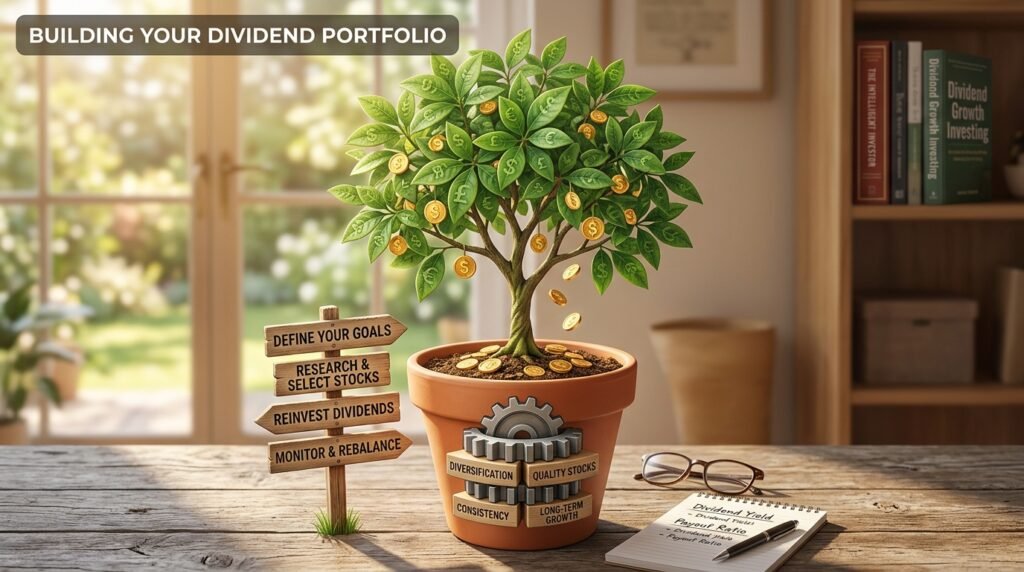
Okay, you have a list of great stocks. Now what? You don’t have to buy them all at once.
Start Small, Think Big
You don’t need thousands of dollars to start. Many brokers now allow you to buy fractional shares. If you love Coca-Cola but only have $50, you can buy a fraction of a share and still collect a proportional dividend .
Reinvest Those Dividends (DRIP)
This is the secret sauce. Most brokers offer a Dividend Reinvestment Plan (DRIP). This automatically uses your dividend cash to buy more shares of the stock. It’s like a snowball rolling downhill. Over 10, 20, or 30 years, this compounding effect builds massive wealth.
Don’t Chase the Highest Yield
If a stock yields 10% and another yields 3%, the 10% one might look better. But remember safety. A high yield can be a red flag. Look for yields between 2% and 6% from the companies we listed. That is the sweet spot where income meets stability.
Dividend Safety Checklist: A Quick Guide
Before you hit the “buy” button on any of these safe dividend stocks to buy, run it through this quick mental checklist:
- Check the Streak: Has the company raised dividends for at least 10 years? (25+ is better).
- Check the Payout Ratio: Is it below 75%?
- Check the Business: Do you understand how they make money? Do they sell something people will always need?
- Check the News: Are they facing lawsuits or losing market share?
If the stock passes all four, it’s probably a solid addition.
Frequently Asked Questions (FAQs)
Q: How much money do I need to start buying dividend stocks?
A: You can start with as little as $5 or $10 if your brokerage allows fractional shares. The key is consistency, not the starting amount.
Q: Are dividend stocks really safe during a recession?
A: No stock is 100% safe, but Dividend Aristocrats like Coca-Cola or Procter & Gamble have proven they can withstand recessions because people still buy their products .
Q: What is the difference between dividend yield and dividend growth?
A: Yield is the income you get now. Growth is how fast that income increases. For long-term investors, growth is often more important because it protects you from inflation. A stock with a 2% yield that grows 10% a year will eventually pay you more than a stock with a 5% yield that never grows.
Q: Should I buy individual stocks or a dividend ETF?
A: Both are fine. ETFs like the ProShares S&P 500 Dividend Aristocrats ETF (NOBL) or REGL give you instant diversification in one purchase . Individual stocks give you more control and potentially higher income if you pick the right ones. For beginners, ETFs are a great starting point.
Q: How are dividends taxed?
A: In the U.S., most dividends are “qualified” and taxed at the lower capital gains rate rather than as regular income. However, tax laws vary by country and situation. It’s always wise to consult a tax professional.
Your Future Self Will Thank You

Investing doesn’t have to be complicated. You don’t need to chase the hottest tech stock or day trade your way to wealth. The slow, steady path is proven. It has worked for centuries.
By focusing on safe dividend stocks to buy in 2026, you are choosing to partner with the best businesses in the world. You are choosing to get paid while you sleep. You are building a machine that prints money for you, whether you are working, on vacation, or retired.
Start with one stock. Maybe it’s the soda you drink or the store where you buy your tools. Buy a little. Turn on the DRIP. And then forget about it. Check back in 10 years, and you will be amazed at what that small seed has grown into.
The best time to plant a tree was 20 years ago. The second-best time is today. Let’s get planting.
Disclaimer: I am not a financial advisor. This article is for educational and entertainment purposes only. Always do your own research before making investment decisions.