Let’s be real for a second. If you’re reading this, chances are you’re tired of seeing that student loan balance stare back at you every month. You might be a teacher shaping young minds, a nurse working double shifts, or someone just struggling to make ends meet despite that college degree. The good news? The U.S. government offers several paths to wipe away some or all of that debt. But here is the tricky part: you don’t get forgiveness just by existing. You have to apply for it.
Navigating the paperwork can feel like a maze. But don’t worry. In this guide, I’m going to walk you through, step-by-step, exactly how to apply for student loan forgiveness in the USA. We’ll look at the rules for 2026, the different programs available, and the specific actions you need to take to finally get that golden letter saying your loans are forgiven.
First Things First: Do You Have the Right Loans?
Before we jump into the “how,” we need to look at the “what.” Not all student loans are created equal. In fact, most forgiveness programs only apply to federal student loans.
- Federal Loans: These include Direct Subsidized/Unsubsidized Loans, Direct PLUS Loans, and Direct Consolidation Loans. These are your golden tickets.
- Private Loans: Loans from banks, credit unions, or online lenders. Unfortunately, almost no government forgiveness applies here.
Your First Step: Log in to StudentAid.gov using your FSA ID. Go to “My Aid” and scroll down to see what kind of loans you have. If they are federal Direct Loans, you are in the right place. If you have old FFEL or Perkins loans, you might need to consolidate them into a Direct Consolidation Loan to qualify for some programs .
The Big One: Public Service Loan Forgiveness (PSLF)
If you work for the government or a non-profit, this is the program you’ve probably heard about. PSLF is designed to forgive your loans after you’ve made 120 “qualifying” monthly payments—that’s 10 years—while working full-time for a qualifying employer .
Who Qualifies for PSLF?
- Your Employer: You must work full-time for a U.S. federal, state, local, or tribal government agency, the U.S. military, or a tax-exempt 501(c)(3) non-profit organization . Some other non-profits might qualify too, but check the PSLF Help Tool to be sure .
- Your Loans: You must have Direct Loans. If you have other federal loans, you can consolidate them into a Direct Consolidation Loan, but be aware that this resets your payment count to zero.
- Your Payment Plan: You need to be on an Income-Driven Repayment (IDR) plan.
Important Updates for 2026
Step-by-Step: How to Apply for PSLF
Applying for PSLF isn’t something you do just once at the end. It’s a process you should repeat every year or whenever you change jobs. This is crucial to make sure you are on track.
Step 1: Use the PSLF Help Tool
Head over to the PSLF Help Tool. This is your command center.
- Find Your Employer: Search for your employer in the database to see if they qualify. If they aren’t listed, you can still submit a form for the Department of Education to review them .
- Generate the Form: The tool will pre-fill your information and create your PSLF form (officially the “PSLF & Temporary Expanded PSLF Form”).
Step 2: Get Your Employer’s Certification
You’ll need to send this form to your employer’s HR or authorized official.
- They will fill out Section 4, certifying that you work there full-time.
- They can now often do this digitally via the Help Tool, which is much faster. If not, they can print, sign, and give it back to you.
Step 3: Submit the Form
- Digital: If your employer signed electronically, you are done! It goes straight to the servicer (MOHELA).
- Mail/Fax: If you have a paper form, you’ll need to mail or fax it according to the instructions on the form. Pro tip: Always, always make a copy for your records before you send it.
Step 4: Wait for the Payment Count
Once processed (this can take a few months), your loan servicer (now usually MOHELA for PSLF applicants) will tell you how many qualifying payments they have counted toward your 120. Review this carefully. If they missed some, you might need to submit a reconsideration request or a separate form for older payments .
Step 5: Apply for Forgiveness
After you make your 120th payment, you don’t just wait. You need to submit another certification form. Check the box on the form indicating that you believe you have made 120 qualifying payments. Once they verify it, your loans are forgiven, and you get a refund of any extra payments you made after hitting 120.
Income-Driven Repayment (IDR) Forgiveness
Maybe you don’t work in public service. That’s okay. If you have federal loans and you’ve been paying them for a long time (or plan to), you can get forgiveness after 20 or 25 years through an IDR plan.
How IDR Forgiveness Works
You pay a percentage of your “discretionary income” each month. After a set number of years (240 payments for undergraduate loans under some plans, 300 for graduate loans), the remaining balance is wiped away .
Which IDR Plan is Right for You?
There are a few options, but the landscape changed in late 2025 and early 2026:
- SAVE Plan: Currently, the SAVE plan is blocked by lawsuits. Borrowers on SAVE are in an interest-free forbearance. However, these months may not count toward IDR forgiveness right now. The government has proposed ending the SAVE plan, so borrowers are encouraged to use the Loan Simulator to look at other plans like IBR or PAYE .
- IBR, PAYE, ICR: These are still active. Generally, if you are a newer borrower, PAYE or IBR might cap your payments at 10% of your income .
Step-by-Step: How to Apply for IDR Forgiveness
Step 1: Get on the Right Plan
You cannot get IDR forgiveness if you aren’t on an IDR plan.
- Go to StudentAid.gov and log in.
- Use the “Loan Simulator” tool. It will ask you about your income and family size and recommend the cheapest plan.
- You can apply for an IDR plan online. You’ll need to provide your income info. The easiest way is to use the IRS Data Retrieval Tool to import your tax return automatically. If not, you’ll have to upload pay stubs .
Step 2: Recertify Your Income Annually
This is the part where people slip up. You must recertify your income every single year. If you miss the deadline, your payment might skyrocket to the Standard Plan amount, and those months usually won’t count toward forgiveness. Mark your calendar!
Step 3: Track Your Payments
Keep a log. Save every statement. You can check your payment counts on StudentAid.gov. They are now required to show you a count of qualifying payments for IDR forgiveness. If your counts look wrong, contact your servicer immediately.
Step 4: The 2025-2026 Tax-Free Window
Here is a hot tip for 2026: Forgiveness is generally taxed as income. However, thanks to the American Rescue Plan, through December 31, 2025, all federal student loan forgiveness is tax-free .
If you are close to that 20- or 25-year mark, you might be scrambling to get it done by the end of 2025 to avoid a massive tax bill. If you qualify in 2025 but the paperwork is delayed until 2026, the Department of Education has stated the effective date will be 2025, meaning you should still be tax-free . But if you hit 300 payments in 2026? You might owe taxes on the forgiven amount, depending on your state .
Teacher Loan Forgiveness
If you are an educator, this program is separate from PSLF and can get you relief much faster.
Who Qualifies?
- You must teach full-time for five complete and consecutive academic years.
- At least one of those years must have been after the 1997-98 academic year.
- You must teach in a low-income school or educational service agency. You can check if your school qualifies using the Teacher Cancellation Low Income (TCLI) Directory .
How Much Forgiveness?
- Up to $17,500 if you are a highly qualified math, science, or special education teacher.
- Up to $5,000 for other teachers.
Step-by-Step: How to Apply for Teacher Loan Forgiveness
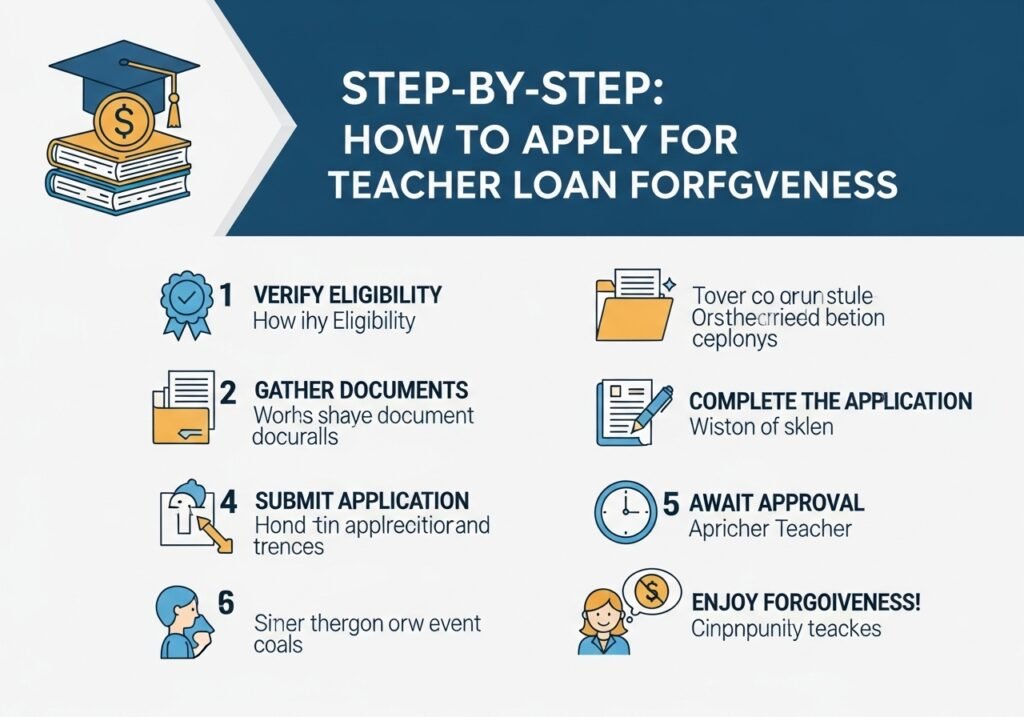
Step 1: Complete Your Service
Finish your five years. Make sure your employment is verified.
Step 2: Fill Out the Application
You need Form ED 2472 – “Teacher Loan Forgiveness Application.”
- Section 1: You fill out your basic info.
- Section 2: The chief administrative officer of the school where you worked must certify your employment.
Step 3: Submit to Your Loan Servicer
Do not send this to the Department of Education in Washington D.C. Send it directly to the company that services your loans (like Nelnet, Aidvantage, MOHELA, etc.). You can find out who your servicer is by logging into StudentAid.gov.
Important Note: You cannot use the same five years of teaching for both Teacher Loan Forgiveness and PSLF. You have to pick one . If you plan to stay in education longer, PSLF might be better because it forgives all of your loans tax-free (through 2025), not just a portion.
Special Forgiveness for Specific Professions
Beyond the big names, there are niche programs for people in specific fields.
Health Care & Legal Professionals
If you are a doctor, nurse, dentist, or lawyer working in underserved areas, you have options.
- National Health Service Corps (NHSC): If you are a primary care medical, dental, or mental health provider, you can get up to $100,000 for a two-year commitment at an approved site in a Health Professional Shortage Area .
- John R. Justice (JRJ) Program: If you are a state or federal public defender or state prosecutor, this program provides student loan repayment assistance .
How to Apply: These are usually competitive and have specific application windows. Visit the NHSC website or the Bureau of Justice Assistance website for details.
National Need — The Lesser-Known $10,000 Forgiveness
Did you know there is a federal law (20 USC 1078-11) that forgives up to $10,000 for people working in “areas of national need”? . This includes:
- Early childhood educators
- Librarians
- Speech-language pathologists
- Nurses employed in clinical settings
- First responders (police, firefighters, EMTs)
- STEM employees
The Catch: This program is subject to appropriations (meaning Congress has to fund it) and works on a first-come, first-served basis . It is not as widely used as PSLF, but it exists. You usually apply through your loan holder, not StudentAid.gov directly.
Discharge Options: When Loans are Canceled Due to Circumstances
Sometimes, forgiveness isn’t about years of service but about life events. This is usually called “discharge.”
Total and Permanent Disability (TPD) Discharge
If you are unable to work due to a disability, you can have your loans wiped clean.
- Eligibility: You must provide documentation from the VA (if you are a veteran with a service-connected disability), the Social Security Administration (if you have a scheduled review of your disability status within 5 to 7 years), or a physician certifying that you are unable to engage in substantial gainful activity due to a physical or mental impairment .
- How to Apply: Go to disabilitydischarge.com. It is a secure site run by the Department of Education. You will submit your application and supporting documents there.
Borrower Defense to Repayment
Did your college lie to you or break state laws? If your school closed suddenly or defrauded you, you might get your loans discharged.
- How to Apply: You submit a “Borrower Defense to Repayment” application through StudentAid.gov. Be prepared to provide evidence of the misrepresentation .
Closed School Discharge
If your school closed while you were enrolled or shortly after you withdrew, you don’t have to pay back federal loans for that period .
The 2026 Checklist: Steps to Protect Your Progress

With all the legal changes happening (the SAVE plan injunction, new PSLF definitions taking effect July 1, 2026), you need to be proactive.
- Consolidate if Necessary: If you have Parent PLUS loans, you must consolidate them before July 1, 2026 to access income-driven repayment plans like IBR and ICR. After that date, unconsolidated PLUS loans will only qualify for the Standard Repayment Plan, which offers no forgiveness .
- Certify Your Employment Early: If you work for a non-profit that might fall under the new “substantial illegal purpose” scrutiny (like immigration legal aid or reproductive health services), certify your employment before July 1, 2026. Those pre-July payments are safe .
- Watch the Tax Deadline: If you are close to 20/25 years of payments on an IDR plan, try to get your forgiveness finalized by December 31, 2025 to avoid federal taxes on the forgiven amount . Check your state rules too—states like Arkansas, Indiana, Mississippi, North Carolina, and Wisconsin may still tax you .
Common Mistakes to Avoid
- Not Submitting the Form: You don’t get PSLF automatically after 10 years. You must apply.
- Wrong Payment Plan: Making 120 payments on a Standard Plan while working for a non-profit won’t count for PSLF unless you are on an IDR plan.
- Assuming Deferment Counts: Generally, time spent in deferment or forbearance before 2013 does not count toward IDR forgiveness, and it never counts for PSLF unless you make a payment during that time .
- Ignoring Your Mail: Your servicer will send you notices about recertification deadlines. Ignoring them is the fastest way to break your payment streak.
Conclusion
Applying for student loan forgiveness in the USA isn’t always easy, but it is worth it. Whether you are a public servant gunning for PSLF, a teacher hitting your fifth year, or a borrower who has been paying for two decades, there is a path forward.
The most important thing you can do right now is take action. Log into your StudentAid.gov account. Check your loan types. Use the PSLF Help Tool. Run the Loan Simulator. The government websites are clunky, but they are the only source of truth.
Your future self—the one without that monthly student loan payment—will thank you for spending the afternoon doing this paperwork.
Frequently Asked Questions (FAQs)
Q: Is student loan forgiveness taxable in 2026?
A: It depends. If your loan is forgiven under PSLF, Total and Permanent Disability, or if you pass away, it is not taxed. For IDR forgiveness, the tax-free status expires on December 31, 2025. If your loan is forgiven in 2026 under IDR, it will likely be considered taxable income by the IRS, though you should check your specific state laws as well .
Q: What is happening with the SAVE plan?
A: As of early 2026, the SAVE plan is blocked by a court order. Borrowers on SAVE are in an interest-free forbearance, but these months are not counting toward loan forgiveness for most people. The Department of Education has proposed ending the plan. If you are on SAVE, you may want to apply for a different IDR plan like IBR to continue making progress toward forgiveness .
Q: Can I get forgiveness if I have Parent PLUS loans?
A: Yes, but you have to take action. You must consolidate your Parent PLUS loans into a Direct Consolidation Loan before July 1, 2026. After that, you can enroll in the Income-Contingent Repayment (ICR) plan. If you make at least one payment on ICR, you can then switch to IBR, which is usually more affordable. After consolidation, you also become eligible for PSLF if you work for a qualifying employer .
Q: How do I know if my employer qualifies for PSLF?
A: The easiest way is to use the PSLF Help Tool on the Federal Student Aid website. You can search for your employer’s name. If they aren’t in the database, you can still submit a form for the Department of Education to make a determination .
Q: What happens if I miss my annual IDR recertification?
A: If you miss your recertification deadline, your monthly payment will increase to the amount required under the Standard Repayment Plan. That higher payment might not be affordable, and more importantly, you will not get credit toward IDR forgiveness for those months until you recertify and get back on the plan.
Q: Can I apply for both Teacher Loan Forgiveness and PSLF?
A: You cannot use the same period of teaching service for both programs. However, you could use five years of teaching to get Teacher Loan Forgiveness, and then continue teaching for another five years to reach the 10-year (120 payments) mark for PSLF. You just can’t double-dip for the same time .
Leave a Reply