Are you lying awake at night wondering how you’ll pay for college? Maybe you’re a parent stressing over tuition bills. Or perhaps you’re an adult thinking about going back to school but worried about the cost.
I get it. Education in America is expensive. Really expensive.Government Student Grants in USA
But here’s the thing you might not know: there’s billions of dollars in free money sitting out there waiting for students like you. It’s called grant money. And unlike student loans, you don’t have to pay it back. Not one penny.Government Student Grants in USA
We’re talking about government student grants in USA that can cover a huge chunk of your education costs. The Federal Pell Grant alone gives eligible students up to $7,395 per year . That’s real money that can pay for tuition, books, housing, and more.Best Online Data Science Master’s Degree in UK.
In this guide, I’m going to walk you through everything you need to know about government student grants in USA. We’ll cover who qualifies, how to apply, the different types of grants available, and the exact steps you need to take to get your share of this money.
Let’s dive in.
What Are Government Student Grants?
First, let’s get clear on what we’re talking about.
A grant is money given to you for school that you do not have to repay . Think of it as a gift. The government gives it to you to help you get an education.Government Student Grants in USA
Grants are different from student loans. Loans you pay back with interest. Grants you keep forever.
Government student grants in USA come from the federal government. They’re part of the federal student aid programs. States and colleges also offer grants, but we’re focusing on federal grants in this guide.Government Student Grants in USA
The most common question I hear is: “Do I have to be poor to get grants?”
The answer might surprise you. While financial need matters for many grants, it’s not the only factor. Things like your family size, your tax filing status, and even what you want to study can affect your eligibility .
The Golden Ticket: The FAFSA Form

Before we talk about specific grants, you need to understand the one thing that unlocks all of them.Government Student Grants in USA
The FAFSA.
FAFSA stands for Free Application for Federal Student Aid. It’s the single most important form you’ll ever fill out for college money .Government Student Grants in USA
Here’s why it matters: every single federal grant requires you to submit the FAFSA . No exceptions. If you don’t fill it out, you’re leaving money on the table.Government Student Grants in USA
The good news? It’s free. It takes most people less than 30 minutes to complete . And it opens the door to not just federal grants, but also state aid and school-based scholarships.Government Student Grants in USA
You can fill it out online at fafsa.gov. For the 2026–27 school year, the form is available now .
The Big One: Federal Pell Grant
Let’s start with the most important government student grants in USA: the Federal Pell Grant.
What Is the Pell Grant?
The Pell Grant is the foundation of federal student aid. It’s been around since 1972 and has helped millions of students afford college . It’s designed for undergraduate students who show exceptional financial need.Government Student Grants in USA
How Much Money Can You Get?
For the 2025–26 award year, the maximum Pell Grant award is $7,395 . The 2026–27 amount will be announced in early 2026, so keep an eye on StudentAid.gov for updates .
Some students can get even more through “year-round Pell.” If you attend an additional school term within the same year (like summer semester), you may qualify for up to 150% of your yearly award .
Who Qualifies for Pell Grants?
Here’s what you need to know about Pell eligibility :
- You must be an undergraduate student
- You cannot have already earned a bachelor’s degree
- You must show financial need based on your FAFSA
- You must meet basic citizenship and enrollment requirements
Don’t let the words “financial need” scare you off. Your eligibility depends on more than just income. The government looks at your family size, tax filing status, and federal poverty guidelines .
You can receive Pell Grants for up to six total years. These years don’t have to be consecutive. So if you started college, left for a few years, and want to go back, you may still qualify .
Real Examples
Let me give you three real examples from the Federal Student Aid office :
- Student A: Lives with family, household income $30,000, family size of 4. Estimated Pell: $4,500
- Student B: Single parent, income $25,000, family size of 2. Estimated Pell: $6,200
- Student C: Dependent student, family income $60,000, family size of 3. Estimated Pell: $1,500
See how it varies? The only way to know what you’ll get is to submit the FAFSA.Government Student Grants in USA
How to Check Your Eligibility
Not sure if you qualify? Use the Federal Student Aid Estimator at StudentAid.gov . It gives you an estimate of how much federal aid you might receive. Just remember: it’s only an estimate. You must complete the actual FAFSA to get real money.Government Student Grants in USA
For the Neediest Students: FSEOG
Next up in our list of government student grants in USA is the Federal Supplemental Educational Opportunity Grant, or FSEOG (pronounced “FEE-seeg”).
What Is FSEOG?
The FSEOG is for undergraduate students with “exceptional financial need” . It’s even more targeted than the Pell Grant. The government gives money directly to participating schools, and the schools award it to their neediest students.Government Student Grants in USA
How Much Can You Get?
Awards range from $100 to $4,000 per year . At some schools, you might get up to $200 per quarter . The exact amount depends on:
- Your financial need
- When you apply (early matters!)
- Other aid you receive
- How much FSEOG money your school has
Important: Funds Are Limited
Here’s the catch with FSEOG: it’s first-come, first-served . Schools get a limited pot of money each year from the Department of Education . Once it’s gone, it’s gone.Government Student Grants in USA
That’s why you need to submit your FAFSA as early as possible. Don’t wait until spring. Do it right after October 1st.
Who Gets Priority?
Students who receive Pell Grants and have the most need get FSEOG funds first . But meeting the criteria doesn’t guarantee you’ll get it. Apply early to maximize your chances.Government Student Grants in USA
For Future Teachers: The TEACH Grant
Now here’s a special type of government student grants in USA that works a little differently.
What Is the TEACH Grant?
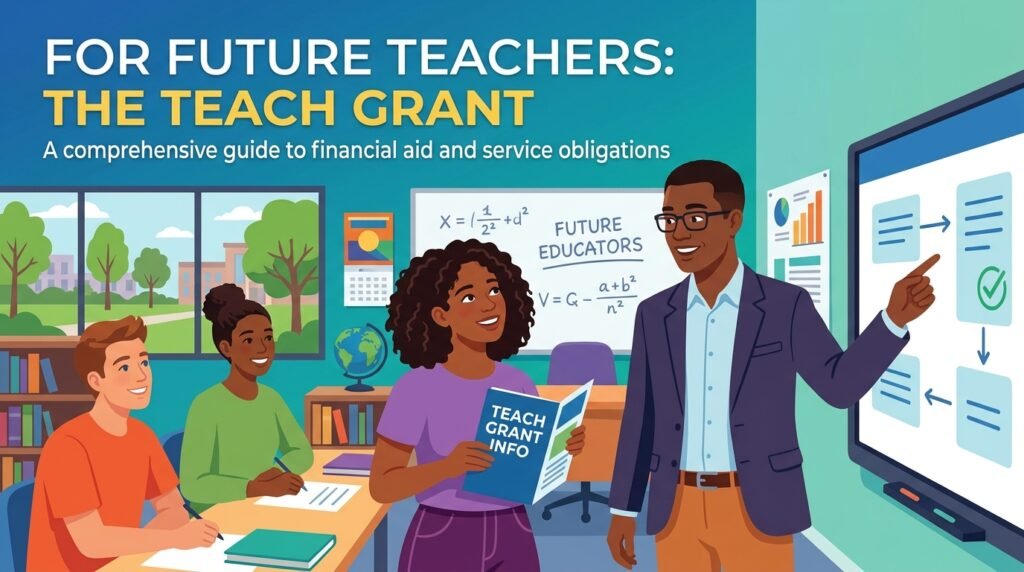
TEACH stands for Teacher Education Assistance for College and Higher Education. It provides up to $4,000 per year to students who plan to become teachers .
But listen carefully: this grant comes with strings attached. Big strings.
The Teaching Obligation
If you accept a TEACH Grant, you agree to :
- Teach full-time in a high-need field
- At a school that serves low-income students
- For at least four complete academic years
- Within eight years of finishing your program
High-need fields include subjects like :
- Math
- Science
- Special Education
- Foreign Languages
- Bilingual Education
- Reading Specialist
The Big Warning
Here’s what you absolutely must understand: if you don’t complete your teaching obligation, your grant turns into a loan. Not just a loan—a Direct Unsubsidized Loan with interest charged from the date the grant was first paid to you .
It has been reported that about one-third of all TEACH Grants disbursed since 2008 have been converted into loans . That’s a scary statistic.
Only accept this grant if you’re 100% committed to becoming a teacher.
Who Qualifies?
To get a TEACH Grant, you must :
- Complete the FAFSA
- Be enrolled in an eligible TEACH-Grant program
- Meet academic requirements (usually a 3.25 GPA or scoring above the 75th percentile on admissions tests)
- Complete TEACH Grant counseling each year
- Sign an Agreement to Serve or Repay
Award Amounts (With Sequestration)
Due to a federal budget rule called “sequestration,” TEACH Grant awards are reduced by 5.7% for grants first disbursed before October 1, 2026 . That means the maximum award is actually $3,772 instead of $4,000 .
Here’s how it breaks down by enrollment at Missouri State University :
- Full-time: $3,772 per year ($1,886 per semester)
- Three-quarter time: $2,829 per year
- Half-time: $1,886 per year
- Less than half-time: $943 per year
For Military Families: Iraq and Afghanistan Service Grant
Some government student grants in USA honor the sacrifice of military families.
What Is the Iraq and Afghanistan Service Grant?
This grant is for students whose parent or guardian died as a result of military service in Iraq or Afghanistan after September 11, 2001 .
Who Qualifies?
- Your parent or guardian was a member of the military and died as a result of service in Iraq or Afghanistan on or after 9/11/2001
- You were under age 33 as of January 1 of the award year (for 2025-26, you must not have turned 33 by January 1, 2025)
- You were eligible for a Pell Grant but don’t qualify because your family income is too high
How Much Can You Get?
The grant award equals the amount of a maximum Federal Pell Grant. For 2025-26, that’s $7,395 .
For Native American Students: BIE Grants
There are also government student grants in USA specifically for Native American students.
What Is the BIE Higher Education Grant?
The Bureau of Indian Education (BIE) offers grants for Native American students pursuing higher education .
Who Qualifies?
- Be a member of, or at least one-quarter degree Indian blood descendent of a member of, an American Indian tribe eligible for BIA services
- Be accepted into an accredited institution offering associate or bachelor’s degrees
- Demonstrate financial need
You can find the Tribal Leaders Directory at bia.gov to confirm your tribe’s eligibility .
Step-by-Step: How to Apply for Government Student Grants
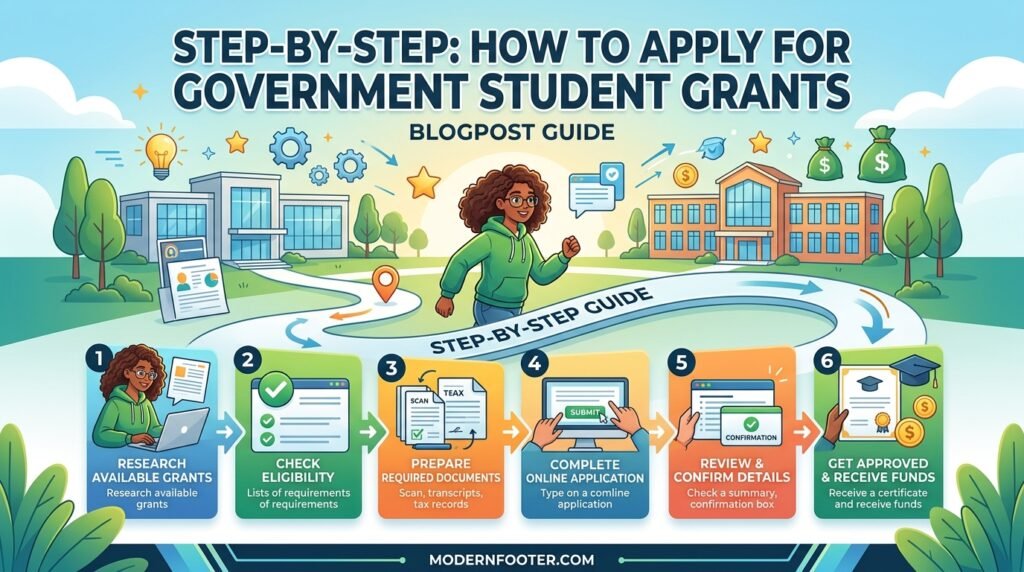
Now you know the grants. Let’s talk about how to actually get them.
Step 1: Create Your FAFSA Account
Before you can do anything, you need a StudentAid.gov account . Go to StudentAid.gov/create-account and set one up. This is your gateway to all federal student aid.
Step 2: Gather Your Documents
- Your Social Security number (or Alien Registration number if you’re not a citizen)
- Your driver’s license (if you have one)
- Your tax returns (or your parents’ tax returns if you’re a dependent student)
- Records of untaxed income
- Bank statements and investment records
Step 3: Complete the FAFSA
Go to fafsa.gov and select “Start New Form” . The form walks you through several sections :
- Student Identity Information: Verify your personal details
- Personal Circumstances: Answer questions about your situation (marital status, dependents, etc.)
- Demographics: Provide information about your background
- Financials: Enter your financial information
If you’re a dependent student, your parents will need to create their own StudentAid.gov accounts and complete their sections .
Step 4: List Schools
You can list up to 10 schools on your FAFSA. These schools will receive your information and use it to determine your aid packages .
Step 5: Sign and Submit
Review everything carefully. Then sign and submit. You’ll get a FAFSA Submission Summary that shows your estimated aid eligibility .
Step 6: Review Your Aid Offers
Once schools accept you, they’ll send financial aid offer letters. These letters list all the aid you qualify for, including grants .
Step 7: Complete Additional Requirements
For grants like the TEACH Grant, you’ll need extra steps like counseling and signing agreements . Make sure you complete everything by the deadlines.
Important Dates for 2026
- October 1, 2025: FAFSA for 2026–27 becomes available
- Early 2026: 2026–27 Pell Grant amounts announced
- Varies by state: Check your state’s financial aid deadline
- June 30, 2027: Last day to submit FAFSA for 2026–27
Remember: for FSEOG and other limited funds, earlier is always better.
Common Questions About Government Student Grants
Q: Do I have to pay back government student grants?
A: No. Grants are free money you don’t repay, as long as you meet the terms . The only exception is the TEACH Grant, which converts to a loan if you don’t fulfill your teaching obligation .
Q: Can I get grants if I go to school part-time?
A: Yes. Grant amounts may be adjusted based on your enrollment status, but part-time students can still qualify .
Q: Do I need good grades to get grants?
A: For most federal grants, you need to maintain Satisfactory Academic Progress (SAP) once you’re in school . The TEACH Grant specifically requires a 3.25 GPA .
Q: Can I get grants for graduate school?
A: Most federal grants are for undergraduates. The TEACH Grant is a notable exception—it’s available for graduate students in teaching programs .
Q: What if my parents won’t provide their information for FAFSA?
A: If you’re a dependent student and your parents refuse to provide information, you’ll only qualify for Direct Unsubsidized Loans. You won’t get Pell Grants or most other federal aid .
Q: How many years can I get Pell Grants?
A: You can receive Pell Grants for up to six total years (or its equivalent) .
Q: Can I get more than one grant at a time?
A: Yes. Many students receive both Pell Grants and FSEOG, or Pell Grants and TEACH Grants, depending on their situation.
Your Money Is Waiting

Here’s the bottom line.
There are billions of dollars in government student grants in USA that go unclaimed every year. Why? Because people don’t apply. They assume they won’t qualify. They think the process is too hard. They wait too long.
Don’t be one of those people.
The path is clear:
- Create your StudentAid.gov account
- Gather your documents
- Fill out the FAFSA as early as possible
- Review your aid offers
- Accept your grants
That’s it. A few hours of work could put thousands of dollars in your pocket for school. Money you never have to pay back.
Whether you qualify for the Pell Grant, FSEOG, TEACH Grant, or one of the other government student grants in USA, the first step is the same: submit that FAFSA.
So what are you waiting for? Head over to fafsa.gov right now and get started. Your future self—the one with less debt and more opportunities—will thank you.
The money is there. It’s yours for the taking. Go get it.