

You bought some Bitcoin a few years ago. You traded it for Ethereum. Then you swapped some of that for a stablecoin. Maybe you even bought a coffee with crypto along the way.
It felt like you were just playing around in the digital world. No big deal, right?
Wrong.
The IRS sees every single one of those moves as a taxable event. And if you haven’t been keeping track, you could be walking into a financial disaster.
Welcome to the 2026 tax season. This year is different. This year, the IRS has new tools, new forms, and a much clearer picture of what crypto investors are doing. If you don’t understand the rules, you could end up overpaying your taxes by thousands of dollars. Or worse, you could trigger an audit.
But don’t panic. I’m here to help.
Think of this as your friendly, straightforward crypto tax guide USA. We’ll walk through everything you need to know: the new Form 1099-DA, how to calculate your cost basis, what happens if you ignore the rules, and exactly how to stay on the IRS’s good side.Crypto Tax Guide USA
Let’s dive in.How to open a Brokerage Account.
Why 2026 Is a Big Deal for Crypto Taxes
If you’ve been filing crypto taxes for a few years, you know it’s always been a bit of a “honor system” situation. You reported what you wanted, and the IRS hoped you were telling the truth.
Those days are over.
Starting with the 2025 tax year (which you’re filing in 2026), the IRS introduced massive changes. The most important one? A brand-new tax form called the 1099-DA .
This form is a game-changer. For the first time, centralized crypto exchanges like Coinbase, Kraken, and Robinhood are required to report your transactions directly to the IRS . They send you a copy, and they send the IRS a copy. The government now knows exactly how much money flowed through your accounts.
This is the most important crypto tax guide USA you’ll read this year because if you ignore these changes, the IRS won’t. They’ll have your data, and they’ll expect your tax return to match it perfectly.Crypto Tax Guide USA
The New Form 1099-DA: What You Must Know
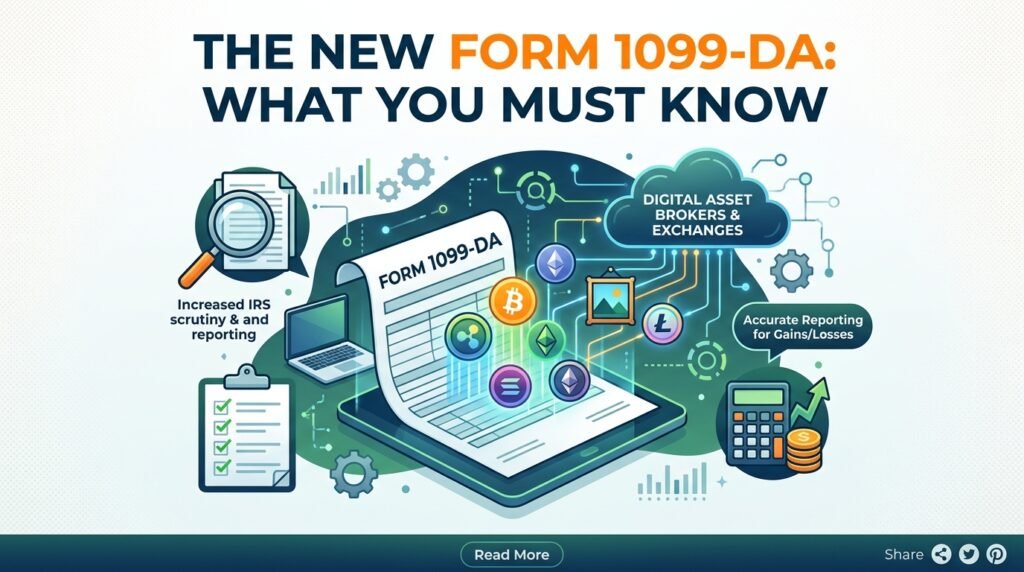
Let’s talk about this new form. It’s the centerpiece of the 2026 tax season.
What Is Form 1099-DA?
Form 1099-DA stands for “Digital Asset Proceeds from Broker Transactions” . It’s similar to the 1099-B you get when you sell stocks. It reports your crypto sales and exchanges to the IRS.
If you used a U.S.-based exchange like Coinbase or Gemini in 2025, you should receive this form by February 17, 2026 .
The Big Catch: Missing Cost Basis
Here’s where it gets tricky. And this is the part every crypto tax guide USA needs to emphasize.
For the 2025 tax year, exchanges are only required to report the gross proceeds from your sales. They do not have to report your cost basis (what you originally paid) to the IRS .
Why does this matter? Let me give you a real example.
Imagine you bought 1 Bitcoin for $20,000 a few years ago. In 2025, you sold it for $100,000.Crypto Tax Guide USA
- Your proceeds are $100,000.
- Your cost basis is $20,000.
- Your capital gain is $80,000.
The 1099-DA you receive will show the $100,000 proceeds. It will not show your $20,000 cost basis. The IRS will receive the same information.
Now, if you file your taxes and only report the $100,000, or if you forget to report the transaction entirely, the IRS computers will see that $100,000 with a cost basis of $0 . They will calculate your tax on the full $100,000, not the $80,000 gain.
In that scenario, instead of paying tax on $80,000, you’d pay tax on $100,000. That could mean thousands of extra dollars owed .
Who Gets a 1099-DA?
You’ll get this form if you had any taxable disposals through a U.S. custodial exchange in 2025 . Taxable disposals include:
- Selling crypto for U.S. dollars
- Trading one crypto for another (like BTC for ETH)
- Converting stablecoins
- Using crypto to pay for goods or services
- Using crypto to pay broker transaction costs
Who Does NOT Get a 1099-DA?
Not every transaction triggers this form. You won’t get a 1099-DA for:
- Transactions on decentralized exchanges (DEXs) like Uniswap
- Activity in self-custody wallets like MetaMask or Ledger
- Transactions on foreign exchanges
- Simply transferring crypto between your own wallets (not a taxable event)
But here’s the kicker: even if you don’t receive a form, you still must report all your taxable crypto activity on your tax return . The IRS expects you to track it yourself.Crypto Tax Guide USA
How the IRS Treats Cryptocurrency

Before we go further, let’s cover the basics. Understanding these rules is essential for any crypto tax guide USA.
Crypto Is Property, Not Currency
The IRS classifies cryptocurrency as property, not currency . That means every time you sell, trade, or use crypto, you trigger a capital gain or loss, just like if you sold a stock or a piece of real estate.
What Counts as a Taxable Event?
You owe taxes when you:
- Sell crypto for dollars
- Trade one crypto for another (even stablecoins!)
- Use crypto to buy goods or services
- Earn crypto from mining, staking, or airdrops (treated as income)
What Is NOT Taxable?
These activities do not trigger taxes:
- Buying crypto with dollars (you only pay tax when you sell)
- Transferring crypto between your own wallets or exchanges
- Donating crypto to a qualified charity
- Gifting crypto (up to certain limits)
Calculating Your Cost Basis: The Heart of the Matter

This is the most important section of this entire crypto tax guide USA. If you take away nothing else, remember this: you must track your cost basis.
Your cost basis is what you originally paid for the crypto, including any fees. When you sell, your gain or loss is the difference between the sale price and your cost basis.Crypto Tax Guide USA
The New Rule: Per-Wallet Accounting
Here’s a major change for 2026. In the past, many investors used the “universal wallet” method. They treated all their Bitcoin as one big pool, regardless of where it was bought.Crypto Tax Guide USA
The IRS now requires you to track cost basis separately for each wallet or exchange account .
Let’s say you bought 1 BTC on Coinbase for $20,000 and 1 BTC on Robinhood for $30,000. Later, you sell the 1 BTC from Robinhood for $40,000. You must use the cost basis specific to that Robinhood purchase ($30,000). You can’t use the cheaper Coinbase basis to reduce your gain artificially.
This makes accurate record-keeping absolutely critical.Crypto Tax Guide USA
Covered vs. Noncovered Securities
You’ll hear these terms a lot this tax season.
- Noncovered securities: Digital assets acquired before January 1, 2026. For these, brokers do not report cost basis to the IRS. You are responsible for tracking and reporting it yourself .
- Covered securities: Digital assets acquired on or after January 1, 2026, and held in the same custodial account until sale. For these, brokers will eventually be required to report cost basis .
For the 2025 tax year (filed in 2026), everything is effectively noncovered . The IRS is not receiving cost basis data from brokers. This puts the burden squarely on you.
Step-by-Step: How to File Your Crypto Taxes
Alright, let’s get practical. Here’s how to navigate this tax season safely.Crypto Tax Guide USA
Step 1: Gather All Your Records
Start by making a list of every platform you used in 2025. This includes:
- Centralized exchanges (Coinbase, Kraken, Gemini, Binance.US, etc.)
- Decentralized exchanges (Uniswap, PancakeSwap)
- Wallet addresses (MetaMask, Ledger, Trust Wallet)
- Any foreign exchanges you used
Collect your Forms 1099-DA from U.S. exchanges. But remember, these forms only tell part of the story .
Step 2: Reconcile Your Transactions
This is the hard part. You need to create a complete record of every transaction, including:
- Buys and sells
- Trades
- Transfers between wallets
- Income from staking, mining, or airdrops
For each transaction, you need:
- Date and time
- Amount of crypto
- Fair market value in USD at the time
- Counterparty (if applicable)
Step 3: Calculate Your Gains and Losses
Using your transaction history, calculate your capital gains and losses for each sale or trade. You’ll need to determine:
- Proceeds (what you sold it for)
- Cost basis (what you paid, including fees)
- Gain or loss
- Whether it’s short-term (held less than one year) or long-term (held more than one year)
Short-term gains are taxed at your ordinary income rate (higher). Long-term gains have lower, preferential rates.Crypto Tax Guide USA
Step 4: Report on Your Tax Return
You’ll report your crypto transactions on:
- Form 8949: Sales and other dispositions of capital assets. This is where you list each individual trade or a summary.
- Schedule D: Summarizes your total capital gains and losses.
- Schedule 1: If you received crypto as income (mining, staking, etc.), you report it here, and it flows to your Form 1040.
And don’t forget: answer the digital asset question on your Form 1040 truthfully. Everyone must check “Yes” or “No” .
Step 5: Pay What You Owe
If you owe taxes, pay them by the April deadline. If you can’t pay, file for an extension or set up a payment plan with the IRS. Ignoring the bill makes it worse.Crypto Tax Guide USA
What Happens If You Don’t Comply?
Let’s talk about penalties. This crypto tax guide USA wouldn’t be complete without a warning.
The “Zero Cost Basis” Trap
As we discussed, if the IRS receives a 1099-DA showing $50,000 in proceeds and your return doesn’t include that transaction or doesn’t show a cost basis, their computers may automatically assume your basis was $0 . They’ll send you a bill for tax on the full $50,000, plus interest and penalties.
Fighting this after the fact is a huge headache.
Audit Risk
The IRS has made crypto compliance a priority. They’ve invested in blockchain analytics tools and are actively auditing crypto holders . If your reported transactions don’t match the data they receive from exchanges, you’re inviting scrutiny.
Penalties for Underpayment
If you underpay your taxes, you’ll face:
- Failure-to-pay penalty: 0.5% of your unpaid taxes per month
- Failure-to-file penalty: 5% of your unpaid taxes per month (much higher)
- Accuracy-related penalty: 20% of the underpayment if the IRS decides you were negligent
- Interest: On top of everything, interest accrues on unpaid amounts
In extreme cases of fraud, criminal charges are possible.
Tools and Strategies to Stay Compliant

You don’t have to do this all manually. Here’s how smart investors handle it.
Use Crypto Tax Software
Programs like CoinTracker, Koinly, and TokenTax can save your sanity. They connect to your exchanges and wallets, import your transaction history, and calculate your gains and losses automatically . Many can generate your Form 8949 directly.
Given the complexity of per-wallet accounting and the new 1099-DA rules, software is almost a necessity for anyone with more than a handful of trades.
Work with a Crypto-Savvy CPA
If your situation is complex—if you’ve used DeFi protocols, had large gains, or are unsure about your records—hire a professional. Look for a CPA who specializes in crypto . They can help you reconcile your data and ensure you’re not missing anything.
Keep Meticulous Records
Even with software, keep your own records. Save confirmation emails, transaction IDs, and wallet addresses. If the IRS ever audits you, you’ll need to prove your numbers.
Consider Tax-Loss Harvesting
If you have losing investments, you can sell them to realize a loss. These losses can offset your gains and reduce your tax bill. Just be aware of the “wash sale” rules (though they currently don’t apply to crypto, this could change).
Frequently Asked Questions
Q: What is the new crypto tax form for 2026?
A: It’s called Form 1099-DA. U.S. centralized exchanges use it to report your crypto sales and disposals to the IRS .
Q: Do I have to pay taxes if I only traded one crypto for another?
A: Yes. The IRS treats crypto-to-crypto trades as a sale of the original asset and a purchase of the new one. It’s a taxable event .
Q: What if I didn’t receive a 1099-DA?
A: You must still report all your crypto income and gains. The absence of a form doesn’t mean the IRS won’t find out .
Q: How do I calculate my cost basis if I bought crypto years ago?
A: You’ll need to dig up your old records. Look at your exchange history, bank statements showing purchases, or any records you kept. This is where crypto tax software can be a huge help .
Q: What happens if I report my crypto wrong?
A: You could overpay (if you miss deductions) or underpay (if you omit income). Underpayment can lead to IRS notices, penalties, and interest .
Q: Is staking rewards taxable?
A: Yes. Staking rewards are generally treated as income at the time you receive them, based on their fair market value .
Q: What’s the deadline to file crypto taxes?
A: The same as regular taxes: typically April 15. For 2026, that’s April 15, 2026.
Q: Can the IRS really track my crypto?
A: Yes. Exchanges now report to the IRS, and the agency uses blockchain analytics to trace transactions. Assume they can see what you’re doing .
Take Control Before April 15

This crypto tax guide USA has one overarching message: the rules have changed, and you need to change with them.
The days of crypto being a tax-free wild west are over. The IRS has new forms, new data, and new enforcement tools. Form 1099-DA means they already know about your exchange activity. Your job now is to make sure you’re not paying more than you owe—or facing penalties for underpayment.
Here’s your action plan:
- Gather all your records from every exchange and wallet.
- Reconcile your transactions and calculate your cost basis accurately.
- Use software or a professional to prepare your return correctly.
- File on time and pay what you owe.
The worst thing you can do is bury your head in the sand. The IRS is patient, but they’re also persistent. A small mistake today can turn into a major headache years from now.
Take a deep breath. Start gathering your documents. And if you need help, reach out to a crypto tax professional. Your future self—the one not dealing with an IRS audit—will thank you.
This crypto tax guide USA is just the beginning. Now go file those taxes and sleep easy knowing you did it right.