It’s Sunday evening. You’re relaxed Best Robo Advisors in USA. Maybe you’re watching a movie or reading a book. Meanwhile, in the background, complex algorithms are quietly buying and selling investments for you. They are rebalancing your portfolio, harvesting tax losses, and making sure your money is growing exactly how it should.Best Robo Advisor
Sounds like a dream, right?
This is the reality of passive investing with a robo advisor. If you have been putting off investing because you think it’s too complicated, too time-consuming, or you just don’t know where to start, then this article is your golden ticket.How to open Brokerage Account.
We are going to walk through the best robo advisor options available in the USA right now. Whether you have $50 or $50,000, there is a solution for you. By the end of this guide, you’ll know exactly which platform fits your life, and you’ll be ready to set your finances on autopilot.Best Robo Advisor
Let’s get started.
What Exactly is a Robo Advisor? (Explained Like You’re Five)
Imagine you want to bake a cake. You could go buy all the ingredients separately—flour, eggs, sugar—and hope you mix them in the right amounts. Or, you could buy a cake mix. Just add water, stir, and put it in the oven.Best Robo Advisor
A robo advisor is the cake mix of investing.
It’s a digital platform that uses algorithms to manage your money for you . You tell the robot a few things:
- Your Goal: Are you saving for a house? Retirement? A rainy day?
- Your Timeline: Do you need the money in 3 years or 30 years?
- Your Stomach for Risk: Does the stock market dropping 20% make you sick, or do you see it as a sale?
Based on your answers, the robo advisor builds you a portfolio. Usually, this is made up of low-cost ETFs (Exchange Traded Funds). These are baskets of stocks and bonds that give you instant diversification. You own a tiny piece of thousands of companies .
The robot doesn’t sleep. It doesn’t get emotional. It just quietly works in the background, making sure your money stays aligned with your goals. This is the essence of passive investing.
Why 2026 is the Perfect Year to Go “Hands-Off”

You might be wondering, “Why should I use a robo advisor now, instead of just picking my own stocks?”
Fair question. Here is why 2026 is the sweet spot for automated investing.Best Robo Advisor
First, the technology has matured. Early robo advisors were basic. They just threw you into a generic “moderate risk” bucket. Today’s platforms are sophisticated. They offer features like tax-loss harvesting (which we’ll get to later) and direct indexing . Some are even integrating AI to give you conversational advice .
Second, fees matter more than ever. With inflation and economic cycles, every penny counts. The best robo advisor platforms charge a fraction of what human advisors charge . We are talking 0.25% compared to 1% or 2%. Over a lifetime, that difference is huge.Best Robo Advisor
Third, life is busy. You have a job, a family, hobbies. Do you really want to spend your weekends staring at stock charts? Probably not. A robo advisor frees you up to live your life while your money grows.Best Robo Advisor
How We Picked the Best Robo Advisors
To make this list, we looked at several factors:
- Fees: Are they reasonable and transparent?
- Account Minimums: Can a beginner get started?
- Features: Do they offer tax-smart strategies?
- Ease of Use: Is the app intuitive?
- Human Help: Can you talk to a person if you freak out?
Let’s dive into the top contenders for 2026.
The Best Robo Advisors in the USA for 2026
1. Wealthfront: The Best Overall Robo Advisor
If you want the full package—sophisticated features, low fees, and a beautiful app—Wealthfront is hard to beat. The Motley Fool actually named it the “Best Robo Advisor Overall” for 2026 .Best Robo Advisor
Why it stands out:
Wealthfront is like the luxury car of robo advisors. It’s smooth, powerful, and packed with tech. Their flagship feature is tax-loss harvesting. This sounds complicated, but here’s the simple version: when the robot sells an investment at a loss, it immediately buys something similar. That loss can offset your taxes on gains elsewhere. For people in high tax brackets, this is pure gold .
The Details:
- Fees: 0.25% annual advisory fee .
- Minimum: $500 to get started .
- Best For: Investors with larger balances who want to maximize after-tax returns.
- Standout Tool: “Path,” their financial planning tool. It’s amazing for mapping out goals like buying a house or sending a kid to college .
The Vibe: You are a bit of a tech nerd. You want the latest and greatest tools to optimize your wealth.Best Robo Advisor
2. Schwab Intelligent Portfolios: The Best for Low Costs (Zero Fees!)
Yes, you read that right. Zero advisory fees.
Schwab shook up the industry a few years ago by eliminating the management fee on their robo service. You still pay the expense ratios on the ETFs in your portfolio (which are tiny), but you don’t pay Schwab a separate percentage fee .
Why it stands out:
It’s backed by Charles Schwab, a giant in the financial world. You get the stability of a massive institution with the convenience of a robot. They automatically build and manage a diversified portfolio for you .Best Robo Advisor
The Details:
- Fees: $0 advisory fee. You only pay the internal fund fees.Best Robo Advisor
- Minimum: $5,000.
- Best For: People who want a trusted brand and hate paying explicit fees.
- Standout Feature: If you have more money ($25,000+), you can opt for “Schwab Intelligent Portfolios Premium,” which gives you unlimited access to certified financial planners for a one-time planning fee and a low monthly fee.
The Vibe: You are practical. You trust the big banks, but you don’t want to pay them a fortune.
3. SoFi Automated Investing: The Best for Beginners and the “Ecosystem” Lover
SoFi started as a student loan refinancing company. Now, it’s a full-on financial ecosystem. They do banking, loans, credit cards, and investing . Their robo advisor is designed to be dead simple.
Why it stands out:
If you are just starting out and you want everything in one app, SoFi is the move. You can see your checking account, your savings, and your investments in one screen. They also offer a unique perk: 1% match on deposits for SoFi Plus members . That’s free money on top of your investments.
The Details:
- Fees: 0.25% annual advisory fee .
- Minimum: Just $50 .
- Best For: Beginners and people who want to manage their whole financial life in one app.
- Standout Feature: Access to human financial planners for a 30-minute complimentary session . If you get nervous, you can talk to a real person without paying ongoing high fees.
The Vibe: You are just starting your journey. You want it simple, cheap, and integrated with your banking.
4. Vanguard Digital Advisor: The Best for Retirement Purists
Vanguard is the company that invented index funds for the average person. They are the kings of low-cost investing. Their robo advisor, Vanguard Digital Advisor, is focused heavily on retirement .
Why it stands out:
It’s cheap. Really cheap. The net advisory fee is around 0.15% to 0.16% . That’s almost nothing. Plus, they waive the fee for the first 90 days .
The Details:
- Fees: ~0.15% .
- Minimum: $100 .
- Best For: Long-term retirement savers who trust the Vanguard way.
- Standout Feature: They offer three portfolio types: All-Index, Active/Index (which includes some actively managed funds), and ESG (Environmental, Social, Governance) . They also have great financial planning tools like a debt payoff calculator .
- The Catch: You are limited to Vanguard funds (which are great, but it’s less choice). Also, there is no access to human advisors at this level . If you want that, you need to upgrade to Vanguard Personal Advisor Services with a $50,000 minimum.
The Vibe: You are a “set it and forget it” retirement saver. You care about low costs above all else.
5. M1 Finance: The Best for “Control Freaks” Who Want Automation
M1 Finance is a hybrid. It’s not a pure robo advisor, and it’s not a pure stock broker. It’s something in between. They call it “finance super app.”
Why it stands out:
M1 lets you build a “Pie” of investments. You decide exactly which stocks or ETFs you want to own (up to 100 “slices”) . Then, the robot automates everything else. When you deposit money, it buys the slices that are underweight to keep your pie balanced.
The Details:
- Fees: $0 for basic (M1 Finance Plus has a fee for extra perks).
- Minimum: $0 .
- Best For: Investors who want to choose their own investments but want the automatic management of a robo.
- Standout Feature: They offer “Smart Transfers” and borrowing features. You can get a low-cost line of credit based on your investments.
The Vibe: You like to be in the driver’s seat, but you want a self-driving car. You want to pick the stocks, but you don’t want to manually rebalance.
6. Ellevest: The Best for Women (and Anyone Who Wants a Different Perspective)
Ellevest was founded by Sallie Krawcheck to address the gender investing gap. Their algorithms are built differently. They account for the fact that women often live longer and have different salary curves than men .
Why it stands out:
Traditional financial models don’t account for career breaks or the wage gap. Ellevest does. They also let you keep your emergency fund in cash within the app without charging a fee on it, which is brilliant .
The Details:
- Fees: Starts at 0.25% .
- Minimum: Varies, but designed to be accessible.
- Best For: Women who want an advisor that understands their specific financial journey.
- Standout Feature: They offer career coaching and salary negotiation advice . It’s holistic financial health.
The Vibe: You want your money to work for you in a way that respects your life path.
7. Wealthsimple: The Best for Socially Conscious Investors
Wealthsimple makes investing feel cool and ethical. They have a strong focus on socially responsible investing (SRI) .
Why it stands out:
They offer a “Socially Responsible” portfolio that invests in companies focused on clean technology, diversity, and community investment. They also offer a “Halal” portfolio that is screened for Shariah compliance .
The Details:
- Fees: 0.2% to 0.5% .
- Minimum: $0 .
- Best For: Investors who want their money to align with their values.
- Standout Feature: They give you a free 15-minute phone call with a human advisor when you sign up .
The Vibe: You care about the planet and social justice, and you want your portfolio to reflect that.
Comparing the Fees: The Silent Wealth Killer
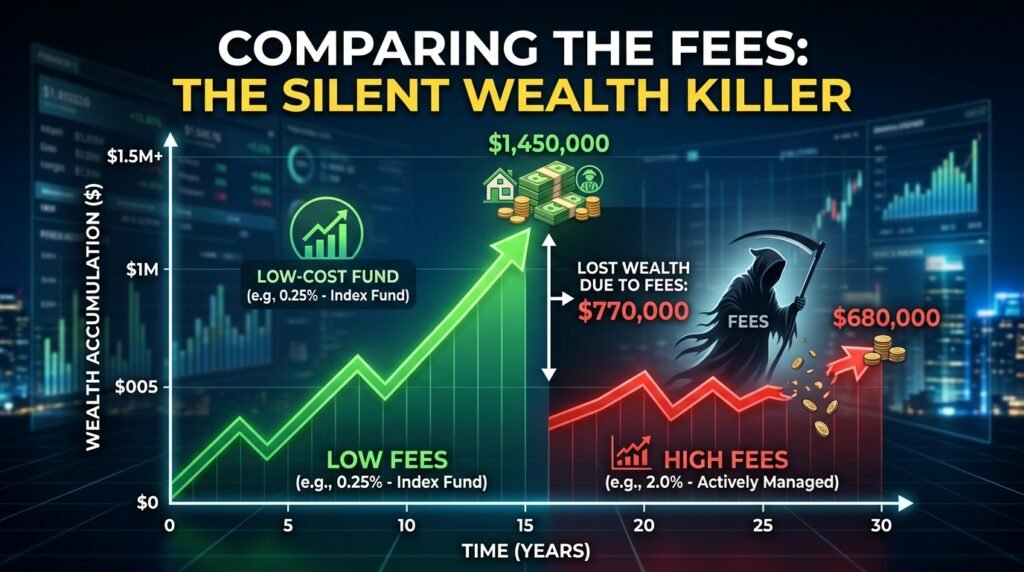
To give you a clear picture, here’s a quick cheat sheet on the best robo advisor fees:
- Vanguard Digital Advisor: ~0.15%
- Schwab Intelligent Portfolios: 0% (just fund fees)
- Wealthfront: 0.25%
- SoFi: 0.25%
- M1 Finance: 0% (for basic plan)
- Ellevest: Starts at 0.25%
- Wealthsimple: 0.2% – 0.5%
Why does 0.10% matter? Let’s do the math.
Imagine you invest $10,000 and it grows at 6% for 30 years.
- At a 0.25% fee, you end up with about $51,000.
- At a 1% fee (typical human advisor), you end up with about $43,000.
That $8,000 difference is going to the advisor, not to you. Keep your fees low .
Key Features to Look For
When you pick your best robo advisor, look for these features:
Automatic Rebalancing
Over time, some investments grow faster than others. If you wanted 60% stocks and 40% bonds, you might end up with 70/30. That’s riskier. The robo automatically sells the winners and buys the losers to get you back to 60/40 .
Tax-Loss Harvesting
We touched on this with Wealthfront. This is when the robo sells an investment at a loss to offset your capital gains taxes. It’s like finding money in your couch cushions, but it’s the IRS giving it back to you .
Goal Setting
The best robo advisor apps let you set multiple goals. Maybe you have a “Retirement” goal and a “New Car” goal. The robot will manage separate portfolios for each, because the timelines are different .
Fractional Shares
This is a must. It means if a stock costs $500, but you only have $50, you can buy 0.1 of a share. This allows you to be fully invested without needing thousands of dollars .
Robo Advisor vs. Human Advisor: Which Do You Need?
This is a common crossroads.
Stick with a Robo Advisor if:
- You are just starting out.
- You have a simple financial life (one job, no rental properties, no trust funds).
- You want to keep costs super low.
- You don’t get emotional about market swings .
Consider a Human Advisor if:
- You have a high net worth or complex situation (over $500k+).
- You are going through a major life change (divorce, inheritance, selling a business) .
- You need help with estate planning or tax shelters that go beyond basic investing.
Some services, like Vanguard Personal Advisor, offer a hybrid model. You get the algorithm and a human for a slightly higher fee (around 0.30%) . This is a great middle ground.
How to Get Started in 5 Easy Steps
Ready to dive in? Here is your action plan:
- Pick Your Platform: Choose one from the list above. If you are a beginner, start with SoFi or Wealthfront. If you want zero fees, go Schwab.
- Open an Account: Download the app. You’ll need your ID, Social Security number, and bank info.
- Take the Quiz: Answer the questions honestly. Don’t say you are a risk-taker if you know you’ll panic during a crash.
- Connect Your Bank: Set up your initial deposit and, more importantly, set up recurring deposits. Even $50 a month adds up.
- Turn on DRIP: This stands for Dividend Reinvestment. It automatically buys more shares with any dividends you earn. It’s the snowball effect.
Frequently Asked Questions (FAQs)
Q: Is my money safe with a robo advisor?
A: Yes, as long as you use a reputable, SEC-registered firm (like all the ones listed here). Your money is typically held at a top-tier custodian (like Apex Clearing or Pershing). You are protected by SIPC up to $500,000, which protects you if the brokerage fails, but not against market losses .
Q: What if the stock market crashes? Will the robo advisor sell everything?
A: Generally, no. The robo advisor is designed to stick to your long-term plan. It might rebalance (buy more stocks when they are cheap), but it won’t panic-sell unless you change your risk profile.
Q: Can I lose money with a robo advisor?
A: Absolutely. Robo advisors invest in the stock market. The stock market goes down sometimes. There is risk involved. However, because they diversify your money across thousands of companies, you are much safer than if you bought just one or two stocks .
Q: What is the minimum amount I need to start?
A: It varies. SoFi and M1 have $0 minimums. Vanguard is $100. Wealthfront is $500 .
Q: Do I have to pay taxes on my robo advisor account?
A: Yes, if it’s a taxable brokerage account. You pay taxes on dividends and when you sell investments for a profit. However, retirement accounts like IRAs are tax-deferred. The robo advisor usually provides you with tax documents.
Put Your Money on Autopilot and Live Your Life

We spend so much time stressing about money. We worry about saving enough, investing right, and timing the market. The truth is, for most of us, the best robo advisor is the solution.
It removes the emotion. It removes the complexity. It handles the boring, repetitive tasks of rebalancing and harvesting.
Whether you choose Wealthfront for its slick tax tools, Schwab for its zero fees, or SoFi for its all-in-one banking, the most important step is to start.
Open an app. Answer the questions. Set up that automatic deposit.
Your future retired self will thank you. Now, go enjoy your Sunday evening. The robot has got this.
Disclaimer: This article is for informational purposes only and does not constitute financial advice. Investing involves risk, including the possible loss of principal. Please consult with a qualified financial professional before making any investment decisions.