
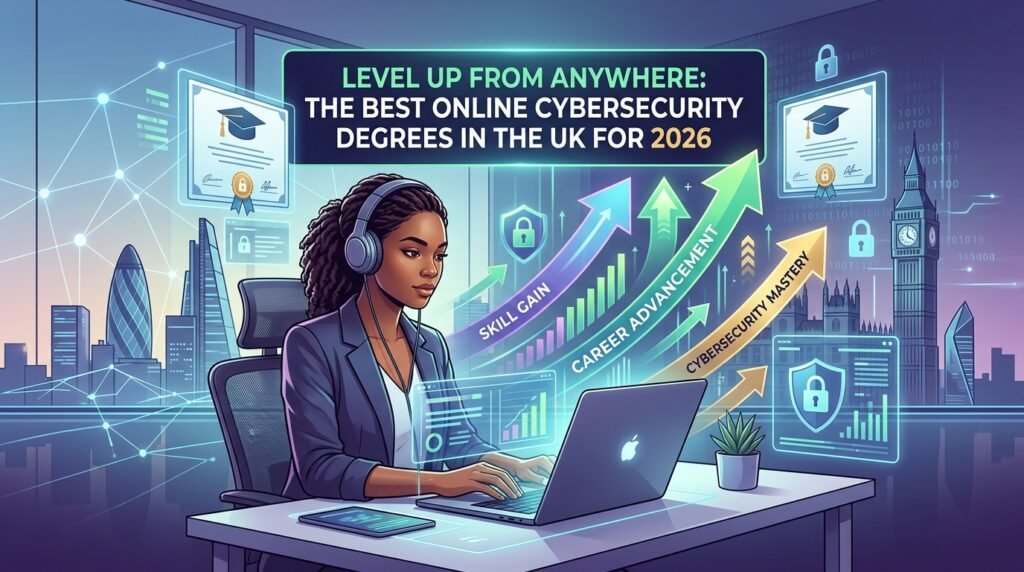
Let’s be real for a second. ”Best Online Cybersecurity Degrees in the UK: Your 2026 Guide”.The world runs on code now. And where there’s code, there’s someone trying to break it. From massive corporations to the person next door, everyone is a potential target for cybercrime. You’ve probably felt that pull toward the “good side” of technology—the world of ethical hacking, digital forensics, and building digital walls that actually hold.
I have good news. It doesn’t have to be that way anymore.
The UK is home to some of the world’s best cybersecurity programs, and a huge number of them are now available 100% online. Whether you are looking to break into the field or climb the ladder to a Chief Technology Officer role, there is a virtual classroom waiting for you.
Why Go Digital? The Perks of Online Learning
Before we dive into the “where,” let’s talk about the “why.” If you’re on the fence about whether online learning is as good as the traditional campus experience, let me stop you right there.
Amjed Saleh, a graduate of Abertay University, put it perfectly. He said the online format allowed him to structure his studies around a “busy schedule without sacrificing quality” . Imagine reviewing lecture materials in the quiet of the early morning or tackling assignments in the evening after the kids are in bed. That is the reality of modern online learning.
It’s not just about convenience, though. It’s about application. Many online courses use virtual labs that simulate real-world networks. You aren’t just reading about a “man-in-the-middle attack”; you are actually seeing how it works in a safe, controlled environment.
Plus, you save money on commuting and accommodation. And let’s be honest, who doesn’t love attending a lecture in their comfy pants?
What Makes a “Best” Degree? The NCSC Gold Standard
Okay, so how do we separate the flashy courses from the ones that actually land you a job? In the UK, there is a secret weapon you need to know about: NCSC certification.
The National Cyber Security Centre (NCSC) is a part of GCHQ. When they certify a degree, it means the course material is top-tier and exactly what the industry needs right now . If you see that little badge on a university’s website, take notice. It means you are learning skills that employers are desperate for.
For example, Northumbria University’s online MSc proudly holds this certification, positioning it “among the best cyber security postgraduate degrees in the UK” . Similarly, King’s College London isn’t just certified; they are recognized as an Academic Centre of Excellence in Cyber Security Research . That means you’re learning from people actively shaping the future of security.
The Heavy Hitters: Top Online Cybersecurity Degrees in the UK

Let’s get down to the nitty-gritty. Here are some of the standout universities offering online cybersecurity degrees, based on course content, accreditation, and real student feedback.
1. King’s College London: The Research Powerhouse
If you want a degree that carries serious weight, King’s College London (KCL) is hard to beat. Ranked 6th in the UK for Computer Science by QS World University Rankings, KCL brings a research-led approach to your screen .
- The Course: Advanced Cyber Security MSc (Online)
- Why it Stands Out: It’s NCSC-certified and taught by experts like Dr. Hannah Cao, who specializes in network security and blockchain .
- What You’ll Learn: You won’t just learn to hack; you’ll master the “why.” The curriculum covers cryptography, network security, ethical hacking, and digital forensics. It’s designed to give you a strong theoretical foundation so you can apply concepts to any real-world situation .
- The Vibe: This is a rigorous, academic program. It’s perfect if you aspire to lead in industry, government, or even move into academic research.
2. Northumbria University London: The Career Booster
Northumbria has designed its online courses with a very clear goal: to get you hired. They actually offer two distinct paths depending on where you are in your career journey .
- The Course:
- MSc Cyber Security (Online): For the pros. If you already have experience in the field, this NCSC-certified program helps you specialize and move into senior roles .
- MSc Cyber Security Technology (Online): For the newcomers. If you are switching careers or don’t have a tech background, this is your golden ticket. It covers the basics, like computer networks and security, alongside leadership skills .
- Why it Stands Out: The focus on “real-life scenarios.” You aren’t just learning theory; you’re doing ethical hacking, penetration testing, and even Linux privilege escalation .
- Flexibility: With start dates in January, April, July, and October, you don’t have to wait for the traditional academic year to begin .
3. University of Roehampton: The Hands-On Specialist
Roehampton offers a program that feels incredibly practical. They emphasize “self-paced modules” and a cutting-edge virtual learning platform, which is music to the ears of busy professionals .
- The Course: Online MSc Cyber Security
- Why it Stands Out: The module list reads like a job description for a modern security team. We’re talking about Governance, Risk and Compliance (GRC), digital forensics, and automating security processes .
- What You’ll Learn: You will get into the weeds of “OS hardening” and learn how to uncover digital evidence with forensic tools. It bridges the gap between technical skills and the strategic frameworks needed to manage risk.
- Affordability: With fees around £9,000 and regional discounts available, it’s a competitive option for a London-based degree .
4. Abertay University: The Flexible Friend
Abertay has a strong reputation for computing, and their online MSc is built for those who need maximum flexibility.
- The Course: MSc in Computing and Cybersecurity (Online)
- Why it Stands Out: Student Amjed Saleh praised its “asynchronous structure,” meaning you don’t have to be online at a specific time. He could study in the morning before work and review readings in the evening .
- The Reality Check: It requires self-motivation, but the support system—discussion forums, group projects, and tutor feedback—keeps you connected . It’s perfect for self-starters who don’t want to feel like they’re alone on an island.
5. University of Essex Online: The Accessible Option
Sometimes, the biggest barrier to entry is the admissions process. Essex Online breaks down that wall.
- The Course: BSc (Hons) Cyber Security
- Why it Stands Out: Student Syed Ahmad came from a background in English literature, psychology, and business studies. He found the entry process “transparent and perfectly suited” to his non-traditional academic background .
- The Experience: Studying via their Virtual Learning Environment (VLE) made him feel like he was living in the future. Everything is in one place, and the peer support is strong . If you are starting from scratch or changing careers, this is a welcoming place to begin.
6. University of London: The Global Classroom
Delivered via Coursera, the University of London’s program offers a truly unique global perspective.
- The Course: MSc in Cybersecurity
- Why it Stands Out: Mirjana, a student from Serbia, chose this because it was the only one that ticked all her boxes: 100% online, affordable, and from a recognized institution .
- The Platform: Coursera integration means you get transcripts of every lecture. This is a huge help for non-native English speakers or anyone who prefers reading along. Plus, students share study strategies, creating a collaborative vibe .
- Real-World Impact: Mirjana used what she learned to convince her manager to stop using “fear-based” security training and start treating cybersecurity as a positive investment. That’s the kind of strategic thinking this course builds .
7. Coventry University: The Practical Choice
Sometimes you just want a solid, reliable education. Based on student reviews, Coventry delivers exactly that.
- The Course: Cybersecurity (BSc)
- Why it Stands Out: Students rave about the “practical, hands-on labs” and the opportunity to work with real-world tools .
- The Feedback: One student mentioned the curriculum is up-to-date, covering everything from network security to digital forensics. While they wished for more direct internship connections, the academic support and approachable lecturers made the experience well-rounded and positive .
Real Talk: What It’s Actually Like to Study Online

Let’s move beyond the brochures. What is a Tuesday night actually like when you’re doing an online MSc?
The Good:
- You Control the Clock: You can fit study around your life, not the other way around. Mirjana did most of her studying on weekends and reviewed notes during her commute .
- Everything is in One Place: Modern Virtual Learning Environments (VLEs) are slick. As Syed noted, “the virtual learning environment (VLE) is well-structured, there’s regular communication and my classmates provide a great support system” . No more lost notebooks.
The Challenge:
- Self-Motivation is Key: Amjed from Abertay gave some honest advice: “Online study offers flexibility, but it requires self-motivation. Use the support available, participate actively, and don’t hesitate to ask for help” .
- Feeling Connected: You have to make an effort. Join the forums. Join the group projects. The students who get the most out of it are the ones who engage, even through a screen.
What Will You Actually Learn? A Peek Inside the Modules
If you are like me, you want to know exactly what you’re signing up for. Here is a snapshot of modules you’ll likely encounter. These aren’t just random topics; they are the building blocks of a modern security expert.
The Technical Core
- Ethical Hacking & Penetration Testing: This isn’t just about using tools. You’ll learn the methodology of an attacker so you can think like one .
- Network Security: From wireless networks to secure protocols, you’ll learn how to architect networks that are “secure by design” .
- Digital Forensics: Ever watched a crime show? This is the real version. You’ll learn how to uncover digital evidence, trace data, and preserve a chain of custody for investigations .
The Strategic Mind
- Governance, Risk, and Compliance (GRC): This is where the big money is. Companies don’t just need techies; they need people who can design risk management frameworks and navigate complex regulations like GDPR .
- Information Assurance and Risk Management: How do you determine what data is most important? How do you convince the board to spend money on security? This module teaches you that strategic oversight .
Where Can This Degree Take You? Career Paths

Let’s talk about the return on investment. The cybersecurity skills gap is real. With cyber attacks on UK businesses hitting over 7.7 million in recent years, companies are desperate for talent . The field is growing by 10-12% annually .
Here are just a few doors that will open for you:
- Cybersecurity Analyst: The frontline defender. You monitor networks, investigate incidents, and report on breaches .
- Penetration Tester (Ethical Hacker): The professional breaker. Companies pay you to hack them before the bad guys do .
- Security Consultant: The expert fixer. You go into organizations, assess their security posture, and tell them exactly what needs to change.
- Risk Analyst / GRC Specialist: The strategic planner. You focus on the “big picture,” ensuring the company follows rules and manages digital risk effectively .
- Chief Technology Officer (CTO): The long game. With a master’s and experience, you can aim for the C-suite, overseeing the entire technology strategy of an organization .
How to Choose Your Perfect Course
With so many great options, how do you decide? Ask yourself these three questions:
- Where am I starting from?
- Newbie/Changing Careers: Look at Northumbria’s MSc Cyber Security Technology or Essex Online. They are designed to bring you up to speed .
- Experienced Pro: Go for an NCSC-accredited program like King’s College London or Northumbria’s standard MSc to validate and deepen your expertise .
- How do I learn best?
- Self-Paced Reader: Abertay’s asynchronous style or University of London’s Coursera platform might suit you .
- Hands-On Tinkerer: Look for programs emphasizing labs and simulations, like Roehampton or Coventry .
- What is my budget?
- Fees vary. Roehampton offers competitive rates around £9,000, while research-intensive universities like King’s are higher, reflecting their extensive resources .
Frequently Asked Questions (FAQs)
Q: Is an online degree respected by employers in the UK?
A: Absolutely. As long as the university is recognized and the degree is the same qualification awarded to on-campus students, employers respect it. In fact, the self-discipline required to complete an online degree can be a major plus on your CV.
Q: Can I study part-time while working full-time?
A: Yes, and that is exactly what these programs are designed for. Most of the students we looked at, like Amjed and Mirjana, worked full-time while studying . The part-time structure (usually 2-3 years) makes it manageable.
Q: I don’t have a STEM background. Can I still apply?
A: For some courses, yes. As we saw with Syed Ahmad at Essex Online, some universities offer pathways for students with non-traditional backgrounds . However, for advanced MSc programs like King’s, you usually need a strong foundation in computer science or maths . Always check the specific entry requirements.
Q: What is the difference between Cyber Security and Cyber Security Technology?
A: Great question! Generally, “Cyber Security” degrees are for those with existing technical knowledge who want to specialize. “Cyber Security Technology” or similar titles are often broader and designed to introduce newcomers to the field, covering foundational IT skills alongside security concepts .
Q: How are exams conducted online?
A: Universities use various methods. Some use “invigilated online exams,” where software monitors your screen and webcam to ensure academic integrity . Others rely more on continuous assessment through coursework, essays, and project reports.
Conclusion: Your Future in Digital Defense Starts Here
The world needs defenders. It needs people who understand the code, the criminals, and the strategies to keep the digital world spinning safely. You don’t have to put your life on hold to become one of those defenders.
Whether you choose the research-led path of King’s College London, the career-focused approach of Northumbria, or the flexible global classroom of the University of London, the opportunity is right at your fingertips.
Take that first click. Request a prospectus. Book a call with an admissions advisor. Your journey to becoming a cybersecurity expert—from the comfort of your own home—starts today.
Leave a Reply